The use of Artificial Intelligence (AI) tools
Mammalogy Notes adheres to COPE's position on the use of Artificial Intelligence tools in its manuscripts.
Thanks to the reviewers of Mammalogy Notes in 2024
We understand that a peer-reviewed journal would not survive without the generous time and constructive feedback of reviewers. For these reasons, we publicly recognize our reviewers annually and invite some of them to become editorial board members for a term, helping to shape the journal's future.
Thanks to our 2023 reviewers in Mammalogy Notes
Mammalogy Notes would like to extend a special thanks to all of our reviewers in 2022, who selflessly donated their time to improve the quality of the work we publish
Thanks to our 2022 reviewers in Mammalogy Notes
Mammalogy Notes would like to extend a special thanks to all of our reviewers in 2022, who selflessly donated their time to improve the quality of the work we publish.
New editors
We welcome two new editors to our Natural History Notes section: Carlos Herney Cáceres-Martínez and Juan Camilo Cepeda-Duque.
New general editor of Mammalogy Notes
Dear readers of Mammalogy Notes,
After an articulated and exhaustive process carried out by the editorial committee of MaNo and the Board of Directors of the Colombian Society of Mammalogy (SCMas), Ivan Mauricio Vela-Vargas has been chosen as the new general editor of our journal.
Mauricio is a Biologist and holds a master’s degree in Biological Sciences from the Pontificia Universidad Javeriana (Bogotá, Colombia) and is a Fellow of the Fulbright Colombia - Minciencias scholar, through which he completed his Ph.D. in Natural Resources with an emphasis on Wildlife Management and Conservation at The University of Arizona (Tucson, USA). Since the founding year of MaNo in 2014, Mauricio has been part of the editorial team of the journal, serving as style editor, reviewer, and associate editor. Currently, he is Big Mammals Leader at the Wildlife Conservation Society (WCS) Colombia program and is dedicated to the evaluation of spatial dynamics and populations of large tropical carnivores, particularly the Andean bear.
Mauricio has extensive editorial experience, serving as a reviewer and associate editor in various national and international scientific journals, and with this expertise, the MaNo editorial team and the Board of Directors of SCMas warmly welcome the new general editor of our journal.
We extend once again our infinite gratitude to Dr. José F. González-Maya, who for 10 years served as general editor, leaving behind extraordinary work and a robust scientific journal with ample growth opportunities.
New editorial section
Permanent editorial to promote the participation of female researchers and students.
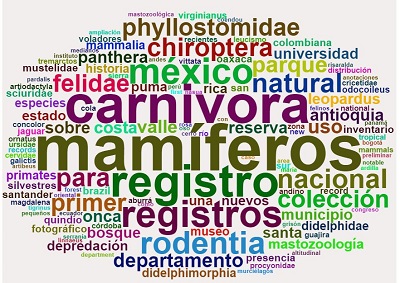
Word cloud
Using our Google Scholar profile we have created this word cloud. Create yours here!
Thanks to the Mammalogy Notes reviewers in 2021
Mammalogy Notes would like to give a very special thanks to all of our reviewers in 2021, who selflessly gave of their time to improve the quality of the work we publish.
We have changed the licenses
Since 2021 we have moved to a license of the type Attribution 4.0 International (CC BY 4.0)

Before 2021 we used the International Attribution-ShareAlike 4.0 license (CC BY-SA 4.0)
Beyond the Notes. Episode 3
Juliana Rodríguez O. tells us the story about her manuscript: Venado Soche predation event (Mazama rufina, Pucheran, 1851) by Taira (Eira barbara Linnaeus, 1758) in Chingaza National Natural Park, Colombia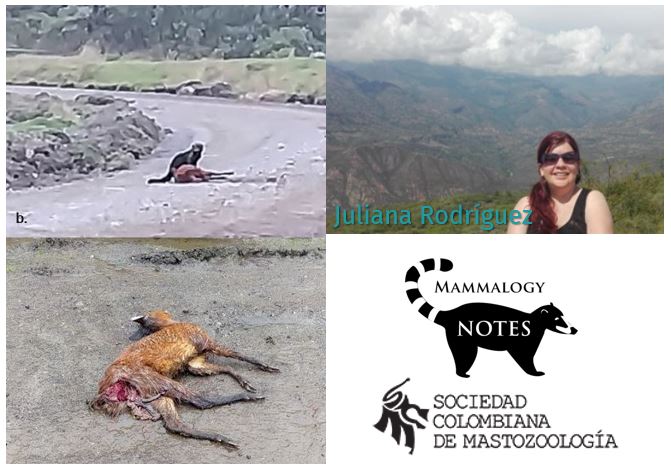
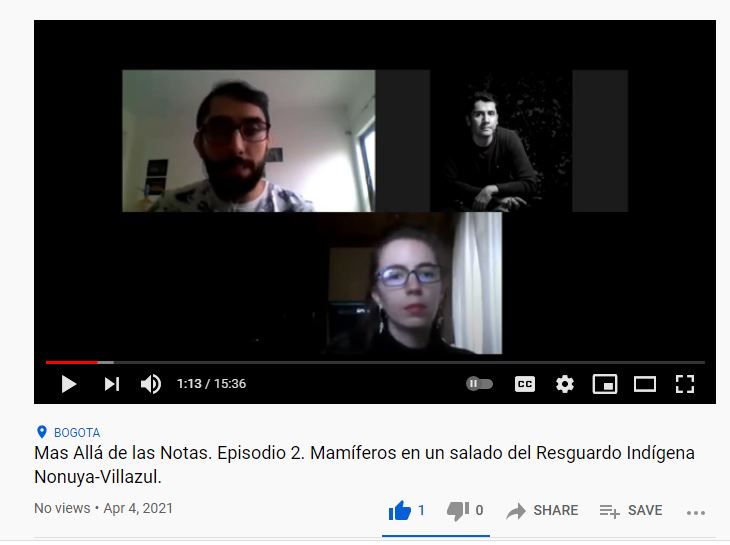
Records of terrestrial mammals in a natural salt lick area of the Nonuya-Villazul Indigenous Reserve, Amazonas department, Colombia
Gabriel Andrade-Ponce tells us the story behind his note about mammals in a salt lick of the Nonuya-Villazul Indigenous Reservation published in Mammalogy Notes.
Cave use by the Broad-footed Climbing Rat Rhipidomys latimanus (Tomes, 1860) in Santander, Colombia
Miguel Rodríguez tells us the story behind his note about the climbing rat in Mammalogy Notes. 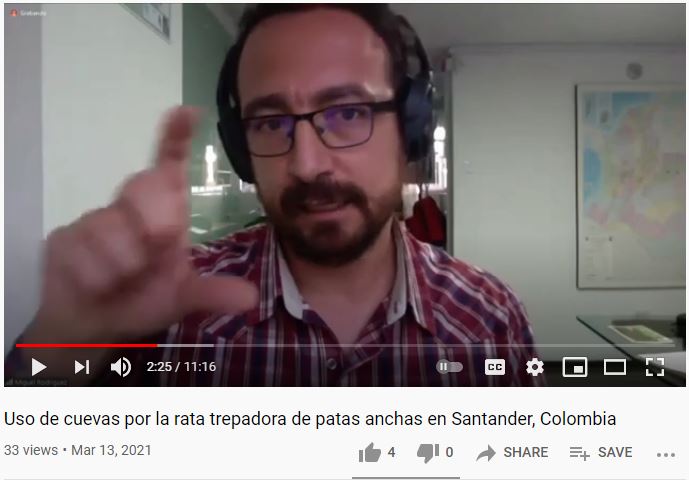
Thanks to our reviewers in Vol. 5 Num. 2 and Vol. 6 Num. 1
Mammalogy Notes wants to thank in a very special way all of our reviewers in the last year, who in an interested way provided their time to improve the quality of the works that we publish.
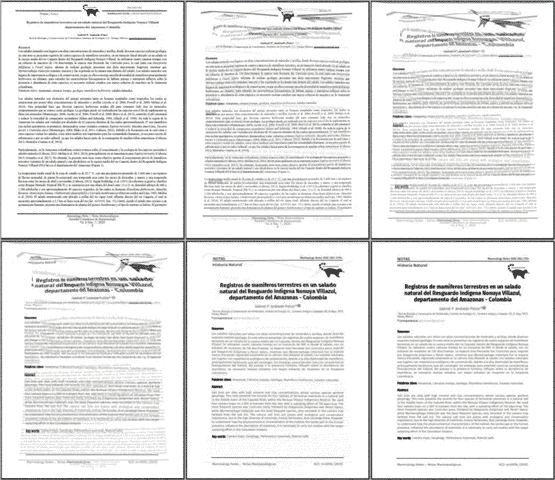
Changes in Mammalogy Notes
After 5 years of publishing Mammalogy Notes, we have completely redesigned our articles, editorial team and author instructions. These changes will be reflected with the publication of volume 6.
Stay tuned!
What We Publish
Mammalogy Notes is open access, which means that all articles published since 2014 are freely available on the Mammalogy Notes website immediately after publication. Mamalogy Notes is published by the Colombian Society of Mastozoology (SCMas) and is distributed under a license: Creative Commons Attribution-Share Alike 4.0 International (CC BY-SA 4.0).


Notes - The notes are the main axis of Mastozoological Notes and will consist of observations, field data and any brief, empirical contribution related to mastozoology. The notes will be divided into the following types:
Distribution extensions: refers to new records on range extension of mammalian species. These records will be corroborated by means of specimens deposited in collections, photos or clear evidence that allow accurate identification of the species in question. The note must clearly incorporate the extension of the distribution and the basis for considering an extension. It must also include the exact location of the registry and information related to the habitat and locality. They must not exceed 1000 words in text (without references). It can include a figure and a table, ideally of the locality compared to the known distribution.
Natural history: refers to remarkable records of natural history, including, but not restricted to, diet, behavior, habits, habitats, predation, among others, related to mammals. The identification of the species and why it is an innovative and unknown contribution of the species must be clearly indicated. They should not exceed 1000 words in text (without references) and may include a figure and a table.
Species inventories: refers to systematic inventories of mammalian species in poorly known areas. It will include specific data on methods and taxonomy of the recorded species, as well as an explicit indication of the study area (exact location, type of habitat, etc.). It will be restricted to 1,200 words (without references), and may include 2 figures and a table (ideally with the species list). Additionally, support material (Supplementary Information) should be included as separate files providing details and information on the taxonomic identification of the species (especially for bats and rodents); In case of collecting catalog and collection numbers where the specimens or photographic support of the identified species were deposited, taxonomic description used for identification and any other information deemed relevant as support of the publication. Inventories will be peer reviewed.
Book reviews: refers to brief reviews of recently published books on mastozoology. It will be restricted to 500 words and will not include tables or figures.
Articles - Original contributions in the field of mastozoology derived from solid scientific research including topics related to ecology, conservation, taxonomy, systematics, biogeography and any other aspect related to mammalian research. They will have a maximum of 6,000 words and will be structured in IMRD format. For the purposes of the magazine, the articles will be considered in their smallest proportion since the focus is notes as mentioned above. Like the inventories of species and, if applicable (eg taxonomic reviews, description of species), support material should be included as separate files providing information on the taxonomic identification of the species (especially for bats and rodents), in case Collect catalog and collection numbers where the specimens were deposited, photographic support of the identified species, and other information deemed relevant as support of the publication. All articles will be reviewed by external peers, in a double-blind system, and managed by a responsible editor.
Correspondence - Original contributions of opinion or review in the field of mastozoology including topics related to ecology, conservation, taxonomy, systematics, biogeography and any other aspect related to mammalian research. They will have a maximum of 1,500 words and these can both discuss articles published in the journal or topics of general interest for the exercise of the discipline. All correspondence will be reviewed by external peers, in a double-blind system, and managed by an editor in charge.