
Keywords
How to Cite
Accepted 2025-04-03
Published 2025-05-19




Abstract
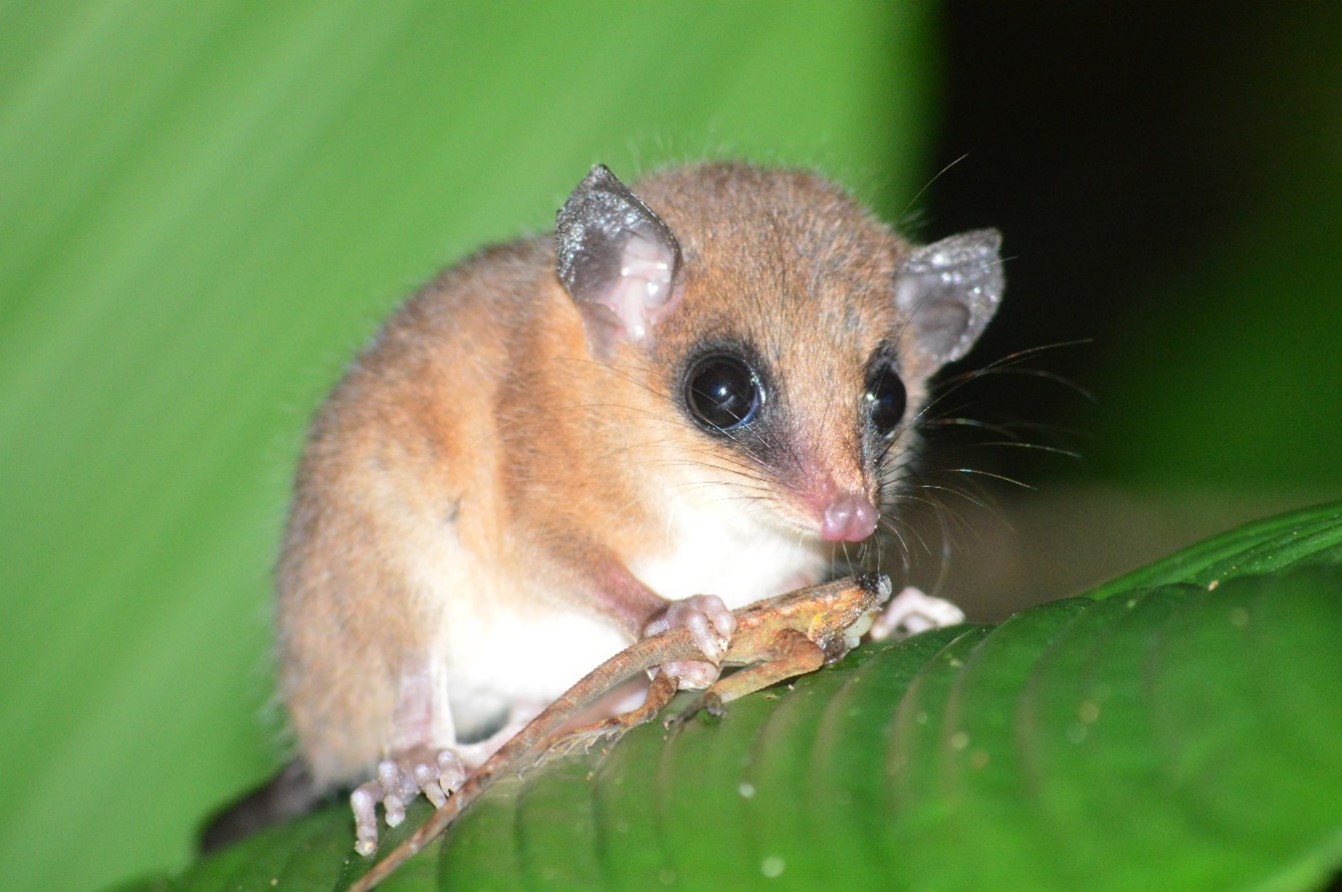
The Zeledon´s Mouse Opossum (Marmosa zeledoni) is a marsupial distributed from Nicaragua to Colombia. This species is considered insectivorous, although it is known to be capable of feeding on small vertebrates. This work documents for the first time the predation of common anole (Norops humilis) by M. zeledoni, through a photographic record in the Community of San Julián, Sarapiquí, Costa Rica, expanding knowledge about the natural history of this marsupial.
References
Acosta-Chaves VJ, Sosa-Bartuano Á, Morera-Chacón BH, Jiménez-Castro JE. 2018. Records of preys hunted by the Zeledon’s Mouse Opossum Marmosa zeledoni Goldman, 1911 (Didelphimorphia: Didelphidae) in Costa Rica. Food Webs. 16:e00094. https://doi.org/10.1016/j.fooweb.2018.e00094.
Alonso-Mejía A, Medellín, RA. 1992. Marmosa mexicana. Mammalian species 421: 1-4. https://doi.org/10.2307/3504312
Astúa D. 2015. Family Didelphidae (Opossums). In: Wilson DE, Mittermeier RA, editors. Handbook of the mammals of the world. 5. Monotremes and Marsupials. Barcelona, España: Lynx Editions. p. 70-186. http://dx.doi.org/10.1093/jmammal/gyw012
Cagnolo L, Valladares G. 2011. Fragmentación del hábitat y desensamble de redes tróficas. Ecosistemas. 20(2-3): 68-78. Recuperado a partir de https://www.revistaecosistemas.net/index.php/ecosistemas/article/view/24
Delgado-Bernal M, Merediz-Durant C. 2022. Ecological consequences of fragmentation on the mammal community in the buffer zone of the Tambopata National Reserve. Ariotake-Revista de Investigación Veterinaria y Amazonía. 1(1):e175. https://doi.org/10.55873/ariva.v1i1.175
Leenders T. 2019. Reptiles of Costa Rica: a field guide. New York, USA: Comstock Publishing Associates.
Paemelaere EA, Guyer C, Stephen-Dobson, F. 2013. The role of microhabitat in predation on females with alternative dorsal patterns in a small Costa Rican anole (Squamata: Dactyloidae). Revista de Biología Tropical 61(2); 887-895. https://doi.org/10.15517/rbt.v61i2.11232
Reid F, Zamora GG. 2022. Pocket guide to the mammals of Costa Rica. New York, USA: Comstock Pulishing Associates.
Reyes‐Olivares C, Guajardo‐Santibáñez A, Segura B, Zañartu N, Penna M, Labra A. 2020. Lizard predation by spiders: A review from the Neotropical and Andean regions. Ecology and Evolution. 10(20):10953–10964. https://doi.org/10.1002/ece3.6801.
Rossi RV, Voss RS, Lunde DP. 2010. A Revision of the Didelphid Marsupial Genus Marmosa Part 1. The Species in Tate’s ‘Mexicana’ and ‘Mitis’ Sections and Other Closely Related Forms. Bulletin of the American Museum of Natural History. 334:1–83. https://doi.org/10.1206/334.1.
Sperr EB, Fronhofer EA, Tschapka M. 2009. The Mexican mouse opossum (Marmosa mexicana) as a flower visitor at a neotropical palm. Mammalian Biology. 74(1):76–80. https://doi.org/10.1016/j.mambio.2008.08.004.

This work is licensed under a Creative Commons Attribution 4.0 International License.