

Keywords
distribution
Mexican Porcupine
threatened species
arboreal mammals
How to Cite
Accepted 2025-10-11
Published 2026-06-25




Abstract
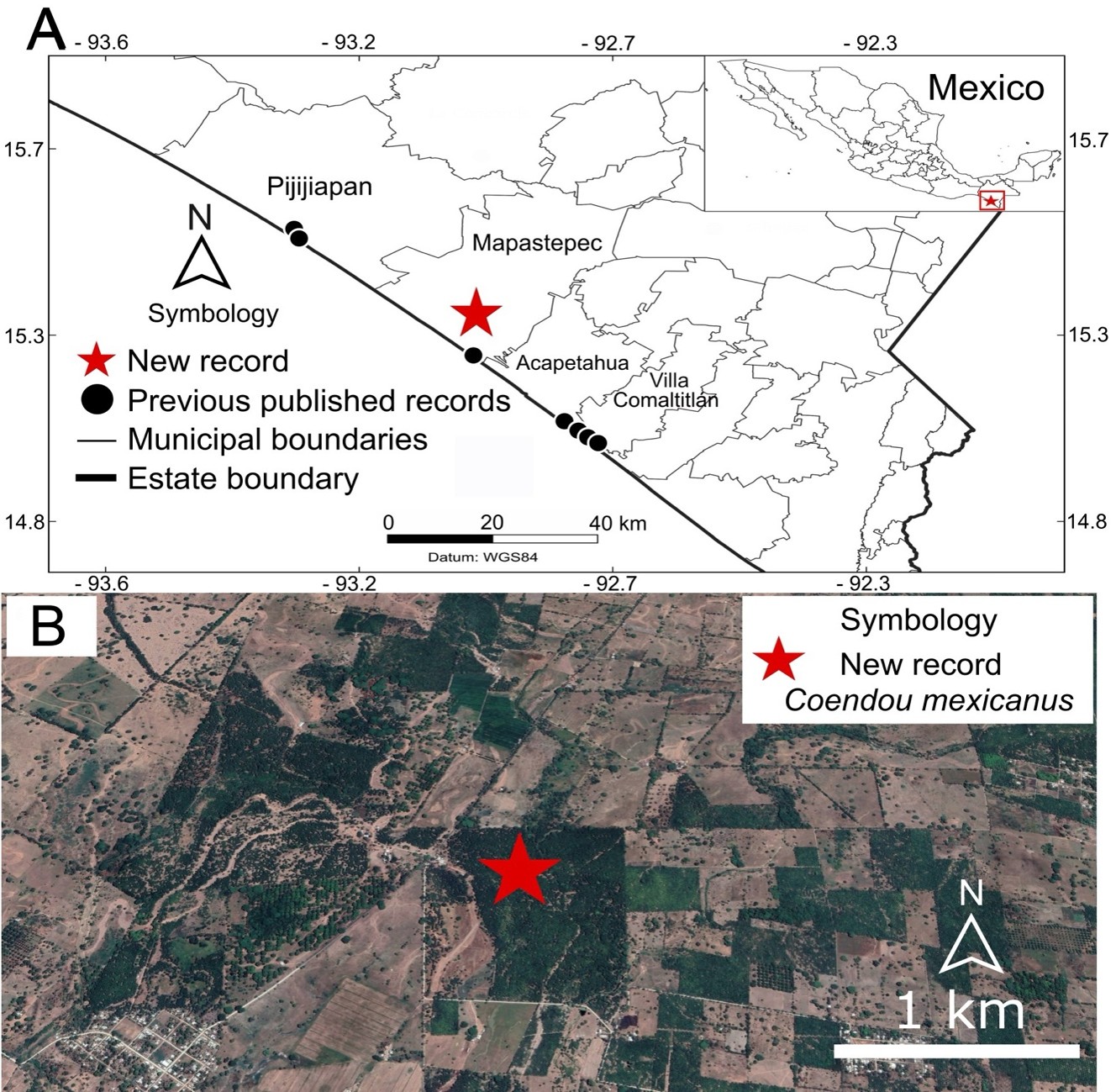
The biology of the Mexican hairy dwarf porcupine, Coendou mexicanus, remains poorly documented, including its distribution and ecology. We report a new direct observation of a juvenile C. mexicanus in the municipality of Mapastepec, Chiapas, Mexico, within an oil palm monoculture plantation and highlight the threats it faces due to the expansion of agricultural activities. The transformation of natural forests into monocultures reduces resource availability for the species, increasing its vulnerability to habitat degradation. Management and conservation strategies that consider the impacts of agriculture on local diversity are needed.
References
Batista-da-Silva JA, Barcellos SJA, Santori RT. 2019. Use of Elaeis guineensis (Arecales: Arecaceae) as shelter and food resource by Coendou spinosus (Rodentia: Erethizontidae) in a mangrove swamp. Oecologia Australis, 23(4), 1104-1108.
Briones-Salas M, Sánchez-Cordero V. 2004. Mamíferos. In: García-Mendoza AJ, Ordoñez MJ, Briones-Salas M, editors. Biodiversidad de Oaxaca. Instituto de Biología, Universidad Nacional Autónoma de México, Fondo Oaxaqueño para la Conservación de la Naturaleza. World Wildlife Fund, México. p. 423-447.
Chamberlain S, Barve V, Mcglinn D, Oldoni D, Desmet P, Geffert L, Ram K. 2025. rgbif: Interface to the Global Biodiversity Information Facility API. R package version 3.8.1. https://CRAN.R-project.org/package=rgbif
Cisneros-Palacios ME, Reyes-Macedo G, Méndez Á, Monroy G, Ramírez Calderón C. 2015. Noteworthy records of tropical porcupine Sphiggurus mexicanus (Erethizontidae) in Oaxaca, México. Therya 6(3):647-652. https://doi.org/10.12933/therya-15-287
Córdoba-Alfaro J. 2016. Presence and distribution of Sphiggurus mexicanus (Rodentia: Erethizontidae) for the South Pacific lowland of Costa Rica. Brenesia 85(86):72-74.
Estrada A, Coates‐Estrada R. 1985. A preliminary study of resource overlap between howling monkeys (Alouatta palliata) and other arboreal mammals in the tropical rain forest of Los Tuxtlas, Mexico. American Journal of Primatology 9(1):27-37. https://doi.org/10.1002/ajp.1350090104
Franquesa-Soler M, Ocampo-Saure F, Mora F, Andrade-Ponce GP, Andresen E. 2023. Socioecological assessment of mammal assemblages in small oil-palm plantations in a highly deforested region in Mexico. Tropical Conservation Science 16(1): https://doi.org/10.1177/194008292311699
GBIF. 2025. Global Biodiversity Information Facility occurrence download. https://doi.org/10.15468/dl.rmhrdg. Accessed on 01 January 2025
Google. 2025. Google Maps. https://maps.google.com/ Accessed on 11 March 2025
Hernandez-Hernandez JC, Chavez C. 2021. Inventory of medium-sized and large mammals in La Encrucijada Biosphere Reserve and Puerto Arista Estuarine System, Chiapas, Mexico. Check List 17(4):1155-1170. https://doi.org/10.15560/17.4.1155
Hidalgo-Mihart MG, González-Gallina A, Iglesias-Hernández JA, Mendoza-Cárdenas N, Pérez-Garduza F, Oliveras de Ita A, Chacón-Hernández A, Vázquez-Zúñiga O. 2022. Mammal use of canopy bridges along the Nuevo Xcan-Playa del Carmen highway, Quintana Roo, Mexico. Folia Primatologica 93(3-6):371-381. https://doi.org/10.1163/14219980-20210902
Lira-Torres I, Sánchez-Rojas G, Ojeda-Ramírez D, Gómez de Anda FR. 2014. New record of the Mexican hairy porcupine Sphiggurus mexicanus (Rodentia: Erethizontidae) in the eastern Sierra of Mexico. Therya 5(1):271-275. https://doi.org/10.12933/therya-14-158
Lorenzo C, Sántiz EC, Navarrete DA, Bolaños J. 2014. Causes and consequences of habitat change rates for the tropical porcupine Sphiggurus mexicanus in Oaxaca, Mexico: Implications for conservation. Revista de Biología Tropical 62(4):1481-1494.
Medellin R. 1994. Mammal diversity and conservation in the Selva Lacandona, Chiapas, Mexico. Conservation Biology 8(3):780-799. https://doi.org/10.1046/j.1523-1739.1994.08030780.x
Monterrubio-Rico TC, Ortega-Rodríguez JM, Mendoza-Cárdenas N, Cancino-Murillo R, Pérez-Arteaga A. 2010. Distributional and ecological records of the Mexican hairy dwarf porcupine (Sphiggurus mexicanus) from Michoacán, Mexico. The Southwestern Naturalist 55(1):139-142. https://doi.org/10.1894/CLG-27.1
Osorio-Rodriguez AN, Vázquez-Arroyo E, Almazán-Catalán JA, Farias DU, Juárez-Agis A, López LAG. 2021. Current distribution of the Mexican hairy dwarf porcupine, Sphiggurus mexicanus, in Guerrero, México. Therya Notes 2:65-72. https://doi.org/10.12933/therya_notes-21-37
Pérez-Irineo G, Santos-Moreno A. 2012. Diversity of large and medium-sized land mammals in a subcaducifolious tropical forest of northeastern Oaxaca, Mexico. Revista Mexicana de Biodiversidad 83(1):164-169.
Posit Team. 2025. RStudio: Integrated development environment for R. Posit Software. http://www.posit.co/
QGIS Development Team. 2024. QGIS Geographic Information System. Open source geospatial foundation project. http://qgis.osgeo.org
Ramírez-Bravo OE. 2012. New records of the Mexican hairy porcupine (Coendou mexicanus) and tamandua (Tamandua mexicana) in Puebla, Central Mexico. Western North American Naturalist 72(1):93-95. https://doi.org/10.3398/064.072.0111
Ramírez-Chaves HE, Torres-Martínez MM, Henao-Osorio JJ, Osbahr K, Concha-Osbahr C, Passos FC, Noguera-Urbano, E. 2022. Distribution update, male genitalia, natural history, and conservation of the stump-tailed porcupine Coendou rufescens in South America. Mammalia, 86(2):160-170.
Rzedowski J. 2006. Vegetación de México. 1ra. edición digital, Comisión Nacional para el Conocimiento y Uso de la Biodiversidad. México. 504 p.
Redford K, Eisenberg J. 1992. Mammals of the Neotropics: The Southern Cone. Chicago and London. University of Chicago Press.
Reid FA. 2009. A field guide to the mammals of Central America and Southeast Mexico. 2nd ed. New York, USA. Oxford University Press.
Riechers-Pérez A. 2004. Análisis mastofaunístico de la zona sujeta a conservación ecológica Laguna Bélgica, Chiapas, México. Anales del Instituto de Biología. Serie Zoología 75(2):363-382.
Roslan SNL, Anwar NI, Yusof MA, Talibe H, Farinordin FA, Izam NAM, Abdullah NA, Ab Wahab MF. 2025. Inventory of non-volant small mammals in the mixed-land use habitats at Pusat Penyelidikan Pertanian Tun Razak, Jerantut, Pahang. Malaysian Journal of Fundamental and Applied Sciences 21(1):1669-1677. https://doi.org/10.11113/mjfas.v21n1.3882
Vázquez E, Reid F, Cuarón AD. 2016. Coendou mexicanus. The IUCN Red List of Threatened Species 2016: e.T20629A22214103. https://dx.doi.org/10.2305/IUCN.UK.2016-2.RLTS.T20629A22214103.en
Wainwright M. 2002. The natural history of Costa Rican mammals. Zona Tropical. San José, Costa Rica.
Wilson D, Reeder D. 2005. Mammal species of the world: A taxonomic and geographic reference. Baltimore: Johns Hopkins University Press.
Yue S, Brodie JF, Zipkin EF, Bernard H. 2015. Oil palm plantations fail to support mammal diversity. Ecological applications 25(8) https://doi.org/10.1890/14-1928.1

This work is licensed under a Creative Commons Attribution 4.0 International License.