
Keywords
Mammals
Serranía de los Yariguíes
How to Cite
Accepted 2026-06-25
Published 2026-08-11




Abstract
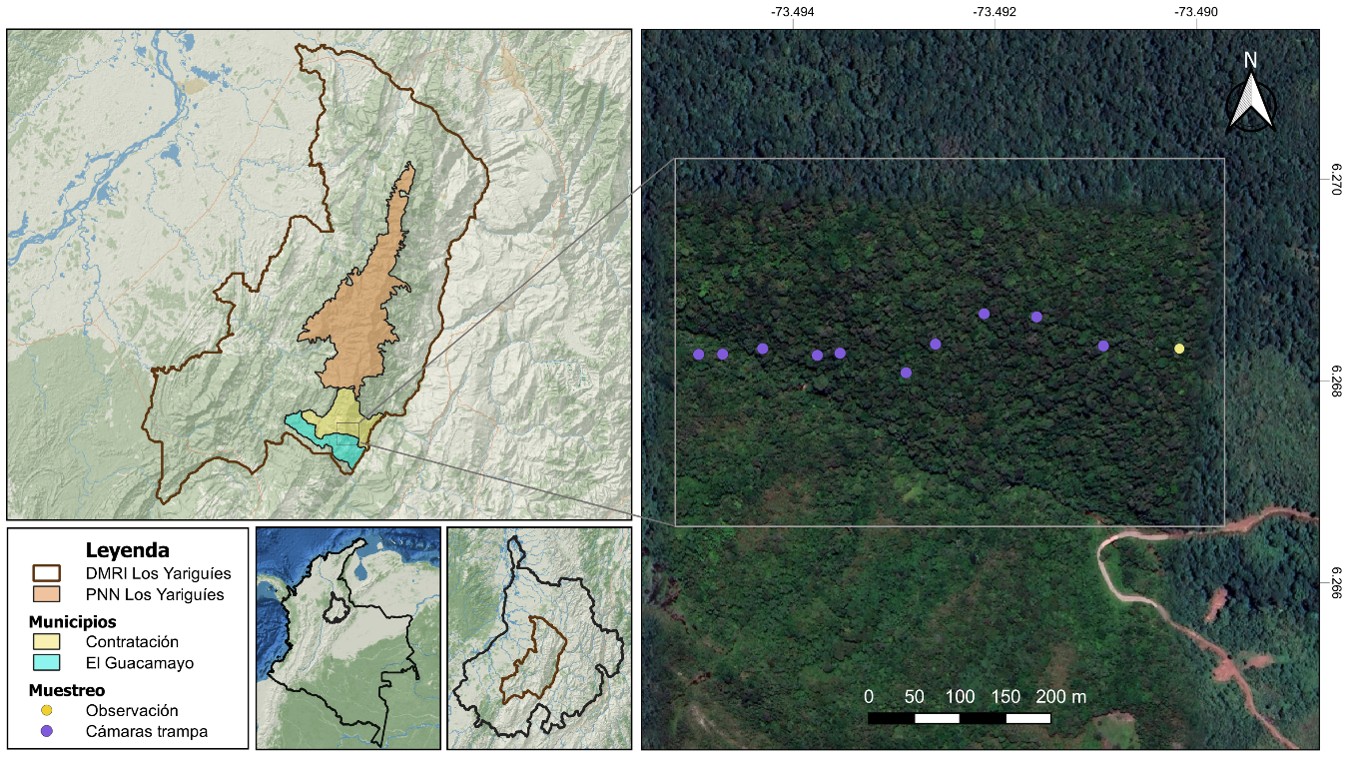
The Serranía de los Yariguíes represents a biologically important area, which is protected under the categories of National Natural Park and Regional District of Integrated Management. Sampling efforts have focused on the northwestern and northeastern slopes, so there are still areas with gaps in biological information. We conducted a short inventory using camera traps and opportunistic observations in an area between the municipalities of Contratación and El Guacamayo (Colombia, Santander), situated on the southeastern slope of the Serranía de los Yariguíes, adjacent to the National Natural Park area. We recorded 15 individuals of seven species and four families: Felidae, Procyonidae, Mustelidae and Ursidae. Notable records include the presence of the Andean bear (Tremarctos ornatus) and the clouded tiger-cat (Leopardus pardinoides), both of which are threatened, as well as new records for the area, such as the Long-Tailed Weasel (Neogale frenata), reflecting the importance of areas adjacent to the National Natural Parks.
References
Barrera-Vargas, J., Delgado-V, C. A., & Arias-Alzate, A. (2023). Mesocarnivores activity patterns in the Northern Colombian Andes. Therya, 14(3), 371-382. http://dx.doi.org/10.12933/therya-23-1243
Barros, A. L., Marques, M., Alcobia, S., MacKenzie, D. I., & Santos-Reis, M. (2024). Comparing the performance of two camera trap-based methods to survey small mustelids. Basic and Applied Ecology, 75, 18-25. https://doi.org/10.1016/j.baae.2024.01.004
Barros-Diaz, C., Macías, M., & Salas, J. A. (2018). Riqueza y abundancia de mamíferos carnívoros en dos áreas con distinto grado de intervención en el Bosque Protector Cerro Blanco (Guayas-Ecuador). Investigatio, 11, 99-112. https://revistas.uees.edu.ec/index.php/IRR/article/view/243
Botero-Cañola, S., Sánchez, J. D., Arias-Alzate, A., Salazar, E., & Solari, S. (2017). Felinos en los ecosistemas andinos de Antioquia. En: Quintero Vallejo, E., Benavides, A.M, Moreno, N., GonzalezCaro, S. (Ed.), Bosques Andinos, estado actual y retos para su conservación en Antioquia (pp. 295-314). https://www.bosquesandinos.org/wp-content/uploads/2018/01/Libro_Bosques_Andinos_Interactivo.pdf
Caro Melgarejo, D., Castro Martínez, A., Cómbita Chivatá, J., et al. (2018). Revelando tesoros escondidos: flora y fauna flanco oriental de la Serranía de Los Yariguíes. Editorial UPTC http://repositorio.uptc.edu.co/handle/001/3897
Carroll, C., Noss, R. F., & Paquet, P. C. (2001). Carnivores as focal species for conservation planning in the Rocky Mountain region. Ecological Applications, 11(4), 961-980. https://doi.org/10.1890/1051-0761(2001)011[0961:CAFSFC]2.0.CO;2
Castilho, C. S., Marins-Sá, L. G., Benedet, R. C., & Freitas, T. R. (2011). Genetic structure and conservation of mountain lions in the South-Brazilian Atlantic Rain Forest. Genetics and molecular biology, 35(1), 65-73. https://doi.org/10.1590/S1415-47572011005000062
CHELSA. (2025). Chelsea climate climatologies at high resolution for the earth’s land surface areas. https://chelsa-climate.org/
de Oliveira, T. G., Fox-Rosales, L. A., Ramírez-Fernández, J. D., C et al. (2024). Ecological modeling, biogeography, and phenotypic analyses setting the tiger cats’ hyperdimensional niches reveal a new species. Scientific Reports, 14(1), 2395. | https://doi.org/10.1038/s41598-024-52379-8z
DeFries, R., Karanth, K. K., & Pareeth, S. (2010). Interactions between protected areas and their surroundings in human-dominated tropical landscapes. Biological Conservation, 143(12), 2870-2880. http://dx.doi.org/10.1016/j.biocon.2010.02.010
Di Minin, E., Slotow, R., Hunter, L. T., Montesino Pouzols, F., Toivonen, T., Verburg, P. H., ... & Moilanen, A. (2016). Global priorities for national carnivore conservation under land use change. Scientific Reports, 6(1), 23814. https://doi.org/10.1038/srep23814
Díaz-Rueda, D. M., Mesa-Ruiz, M., Acosta-Arango, J. D., & Polanía, J. (2019). Registros de Oso Andino (Tremarctos ornatus, Carnivora: Ursidae) en Zapatoca, Serranía de los Yariguíes, Santander, Colombia. Mammalogy Notes, 2(1), 5-7. https://doi.org/10.47603/manovol2n1.5-7
Donegan TM, Huertas BC, Briceño ER, Arias JJ, Camargo I & Donegan MD (2004). Threatened Species of Serranía de los Yariguíes: Project Report. Colombian EBA Project Report Series No. 5. Publicado en línea por Fundación ProAves, Colombia en www.proaves.org. 46 pp
Dos Santos, M. D. F. M., Pellanda, M., Tomazzoni, A. C., Hasenack, H., & Hartz, S. M. (2004). Mamíferos carnívoros e sua relação com a diversidade de hábitats no Parque Nacional dos Aparados da Serra, sul do Brasil. Iheringia. Série Zoologia, 94, 235-245. https://doi.org/10.1590/S0073-47212004000300003
García, L. C., Guillen, R., & Savage, A. (2020). Inventario de mamíferos medianos y grandes en la reserva los Titíes de San Juan, Montes de María, Bolívar, Colombia. Mammalogy Notes, 6(2), 154-154. https://doi.org/10.47603/mano.v6n2.154
Goldstein, I., Paisley, S., Wallace, R., Jorgenson, J. P., Cuesta, F., & Castellanos, A. (2006). Andean bear–livestock conflicts: a review. Ursus, 17(1), 8-15. https://doi.org/10.2192/1537-6176(2006)17[8:ABCAR]2.0.CO;2
Huertas, B.C. & Donegan, T. (eds.). (2006). Proyecto YARÉ: Investigación y Evaluación de las Especies Amenazadas de la Serranía de Los Yariguíes, Santander, Colombia. BP Conservation Programme. Informe Final. Colombian EBA Project Report Series 7, 55-66 & 148-151. www.proaves.org.
IUCN. 2024. The IUCN Red List of Threatened Species. Versión 2024-2. https://www.iucnredlist.org. Accedido en [13 de diciembre de 2024].
King, C. M., McDonald, R. M., Martin, R. D., Tempero, G. W., & Holmes, S. J. (2007). Long-term automated monitoring of the distribution of small carnivores. Wildlife Research, 34(2), 140-148. https://doi.org/10.1071/WR05091
Lima, K. C. B., Passamani, M., & Rosa, C. (2020). Daily tayra (Eira barbara, Linnaeus 1758) activity patterns and habitat use in high montane tropical forests. Acta Oecologica, 108, 103624. https://doi.org/10.1016/j.actao.2020.103624
Malhi, Y., Doughty, C. E., Galetti, M., Smith, F. A., Svenning, J. C., & Terborgh, J. W. (2016). Megafauna and ecosystem function from the Pleistocene to the Anthropocene. Proceedings of the National Academy of Sciences, 113(4), 838-846. https://doi.org/10.1073/pnas.1502540113
Moreno, H. & Tinjacá, Z., 2018. Plan de Manejo del Parque Nacional Natural Serranía de los Yariguíes. Parques Nacionales Naturales de Colombia. https://www.parquesnacionales.gov.co/wp-content/uploads/2020/10/plan-de-manejo-pnn-serrania-de-los-yariguies.pdf
Ostfeld, R. S., & Holt, R. D. (2004). Are predators good for your health? Evaluating evidence for top‐down regulation of zoonotic disease reservoirs. Frontiers in Ecology and the Environment, 2(1), 13-20. https://doi.org/10.1890/1540-9295(2004)002[0013:APGFYH]2.0.CO;2
Palacios-Rodríguez, R. D., Muñoz-Londoño, A. A., & Mantilla-Meluk, H. (2014). Primeros registros de la comadreja de cola larga Mustela frenata (Carnivora: Mustelidae) para el departamento del Quindío, Andes Centrales de Colombia. Revista Biodiversidad Neotropical, 4(2), 170-176. http://dx.doi.org/10.18636/bioneotropical.v4i2.202
Pérez-Irineo, G., & Santos-Moreno, A. (2010). Diversidad de una comunidad de mamíferos carnívoros en una selva mediana del noreste de Oaxaca, México. Acta Zoológica Mexicana, 26(3), 721-736. http://www.scielo.org.mx/scielo.php?script=sci_arttext&pid=S0065-17372010000300014&lng=es&tlng=es.
Pérez-Irineo, G., & Santos-Moreno, A. (2013). Riqueza de especies y gremios tróficos de mamíferos carnívoros en una selva alta del sureste de México. Therya, 4(3), 551-564. https://doi.org/10.12933/therya-13-157
Randler, C., Katzmaier, T., Kalb, J., Kalb, N., & Gottschalk, T. K. (2020). Baiting/luring improves detection probability and species identification—a case study of mustelids with camera traps. Animals, 10(11), 2178. https://doi.org/10.3390/ani10112178
Sheffield, S. R., & Thomas, H. H. (1997). Mustela frenata. Mammalian Species 570, 1-9. https://doi.org/10.1644/0.570.1
Terborgh, J., Lopez, L., Nuñez, P., Rao, M., Shahabuddin, G., Orihuela, G., ... & Balbas, L. (2001). Ecological meltdown in predator-free forest fragments. Science, 294(5548), 1923-1926. https://doi.org/10.1126/science.1064397
Vergara-Asenjo, G., Alfaro, F. M., & Pizarro-Araya, J. (2023). Linnean and Wallacean shortfalls in the knowledge of arthropod species in Chile: Challenges and implications for regional conservation. Biological Conservation, 281, 110027. https://doi.org/10.1016/j.biocon.2023.110027
Villanueva, D. 2006. Estudio de los mamíferos de la Serranía de los Yariguíes y su conservación. En: Huertas B.C. & Donegan T.M. (eds.). Proyecto YARÉ: Investigación y Evaluación de las Especies Amenazadas de la Serranía de los Yariguíes, Santander, Colombia. BP Conservation Programme. Informe Final. Colombian EBA Project Report Series 7, 55-66 & 148-151. www.proaves.org.
Zarco-Mendoza, P., Ríos-Casanova, L., & Godínez-Álvarez, H. (2018). Dispersal and germination of seeds ingested by carnivores in the Zapotitlan de las Salinas Valley, Mexico. Polibotánica, (46), 139-147. https://doi.org/10.18387/polibotanica.46.7

This work is licensed under a Creative Commons Attribution 4.0 International License.