
Keywords
Camera-traps
Mammal fauna
Inventory
How to Cite
Accepted 2025-12-15
Published 2026-03-10




Abstract
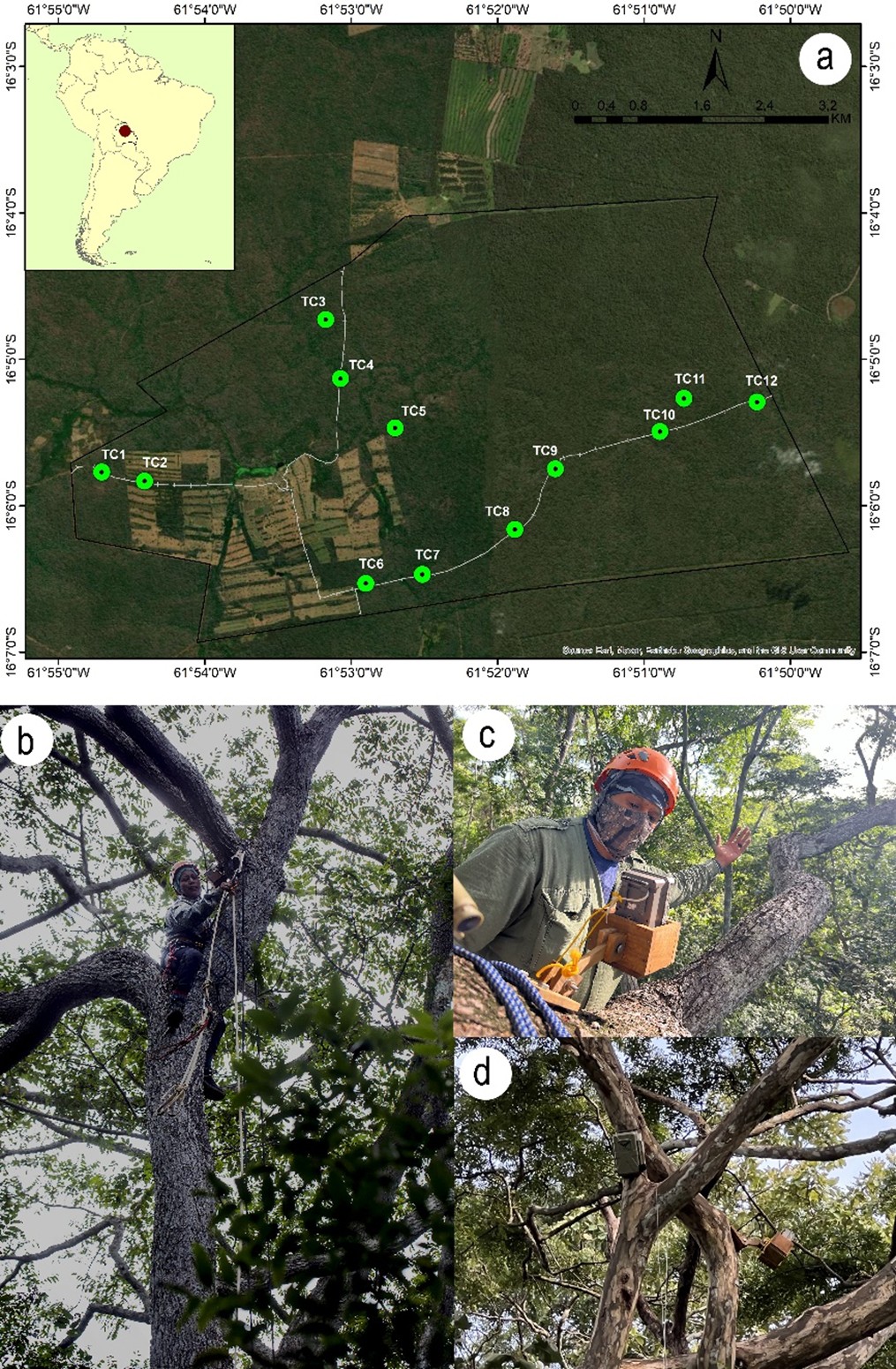
Camera trap studies have contributed notably to understanding the ecology of understory mammal fauna, but little is known about the species that inhabit the canopy. The Center for Tropical Dry Forest Studies “Alta Vista,”, in Santa Cruz, Bolivia, hosts a representative part of the Chiquitano Dry Forest, where studies of local flora and fauna are carried out, our work contributed to the knowledge of the biodiversity of the canopy in this ecosystem. Camera traps were installed between 4 and 20 meters from the ground. With an effort of 804 traps/night, eight species of mammals were recorded, with Glironia venusta and Sapajus apella standing out. Activity patterns showed greater nocturnal activity, providing a basis for future research on canopy mastofauna.
References
Acosta LHS, Barboza-Marquez K, Malpartida NXF. 2024. Nuevo registro de la carachupita de cola lanuda Glironia venusta Thomas, 1912, en el Bosque Seco Chiquitano de Bolivia. Notas sobre Mamíferos Sudamericanos 6:e24.08.4. https://doi.org/10.31687/SaremNMS24.08.4
Alonso A, Dallmeier F, Campbell P, Norgueron R. 2001. The Lower Urubamba Region, Peru. Urubamba: The Biodiversity of a Peruvian Rain Forest. Smithsonian Institution Press, Washington, District of Columbia
Andrade-Ponce. G. 2020. Registros de mamíferos terrestres en un salado natural del Resguardo Indígena Nonuya Villazul, departamento del Amazonas - Colombia. Mammalogy Notes.6(1):0107-0107. https://doi.org/10.47603/manovol6n1.mn0107.
Ardente N, Gettinger D, Fonseca R, de Godoy Bergallo H, Martins-Hatano F. 2013. Mammalia, Didelphimorphia, Didelphidae, Glironia venusta Thomas, 1912 and Chironectes minimus (Zimmermann, 1780): distribution extension for eastern Amazonia. Check List 9(5):1104-1107. https://doi.org/10.15560/9.5.1104
Arguero A, Albuja L, Brito J. 2017. Nuevos registros de Glironia venusta Thomas, 1912 (Mammalia, Didelphidae) en el suroriente de Ecuador. Mastozoología Neotropical 24(1):219-225.
Arispe R, Rumiz DI, Noss AJ. 2007. Six Species of Cats Registered by Camera Trap Surveys of Tropical Dry Forest in Bolivia. Spring:36-38.
A-Sandi AR, Gonçalves ALS, Onizawa K, Yabe T, Spironello WR. 2021. Mammal diversity among vertical strata and the evaluation of a survey technique in a central Amazonian forest. Papéis Avulsos de Zoologia. 61: e20216133. http://doi.org/10.11606/1807-0205/2021.61.33
Ayala GM, Viscarra ME, Ticona H, Wallace RB. 2022. El “Camino de la muerte” o de la vida silvestre: Relevamientos de fauna en el Parque Nacional y ANMI Cotapata (La Paz, Bolivia). Ecología en Bolivia 57(1):19-28.
Bernarde PS, Machado RA. 2008. Mammalia, Didelphimorphia, Didelphidae, Glironia venusta Thomas, 1912: distribution extension to the state of Acre, Brazil. Check List 4(2):151.
Bernarde PS, Rocha VJ. 2003. New record of Glironia venusta (bushy-taile opossum) (Mammalia, Glironiidae) for the state of Rondonia-Brazil. Biociências 11(2):183-184.
Bowler MT, Tobler MW, Endress BA, Gilmore MP, Anderson MJ. 2017. Estimating mammalian species richness and occupancy in tropical forest canopies with arboreal camera traps. Remote Sensing in Ecology and Conservation 3(3):146-157. https://doi.org/10.1002/rse2.35
Burton AC, Neilson E, Moreira D, Ladle A, Steenweg R, Fisher JT, Bayne E, Boutin, S. 2015. Wildlife camera trapping: a review and recommendations for linking surveys to ecological processes. Journal of applied ecology, 52(3):675-685. https://doi.org/10.1111/1365-2664.12432
Calzada J, Delibes M, Keller C, Palomares F, Magnusson W. 2008. First record of the bushy-tailed opossum, Glironia venusta, Thomas, 1912, (Didelphimorphia) from Manaus, Amazonas, Brazil. Acta Amazonica 38:807-809. https://doi.org/10.1590/S0044-59672008000400027
Cuéllar ES, Noss AJ. 2014. Diversidad de mamíferos y participación local en la conservación en el Gran Chaco Boliviano. Therya 5(1):39-60. https://doi.org/10.12933/therya-14-181
da Silva MNF, Langguth A. 1989. A new record of Glironia venusta from the lower Amazon, Brazil. Journal of Mammalogy 70(4):873-875.
Díaz MM, Willig MR. 2004. Nuevos registros de Glironia venusta y Didelphis albiventris (Didelphimorphia) para Perú. Mastozoología Neotropical 11(2):185-192.
Emmons LH, Chávez V, Rocha N, Phillips B, Iam P, del Aguila LF, Swarner MJ. 2006. The non-flying mammals of Noel Kempff Mercado National Park (Bolivia). Revista Boliviana de Ecología y Conservación Ambiental 19:23-46.
Gregory T, Carrasco Rueda F, Deichmann, J, Kolowski, J, Alonso, A. 2014. Arboreal camera trapping: taking a proven method to new heights. Methods in Ecology and Evolution. 5(5): 443-451. https://doi.org/10.1111/2041-210X.12177
Gregory T, Carrasco-Rueda F, Alonso A, Kolowski J, Deichmann JL. 2017. Natural canopy bridges effectively mitigate tropical forest fragmentation for arboreal mammals. Scientific Reports 7(1):1-11. https://doi.org/10.1038/s41598-017-04112-x
Kaizer MC, Alvim TH, Novaes CL, Mcdevitt AD, Young RJ. 2022. Snapshot of the Atlantic Forest canopy: surveying arboreal mammals in a biodiversity hotspot. Oryx. 56(6): 825-836. https://doi.org/10.1017/S0030605321001563
Maillard O, Angulo S, Vides-Almonacid R, Rumiz D, Vogt P, Monroy-Vilchis O, Justiniano H, Azurduy H, Coronado R, Venegas C, Cuellar RL, Montaño R. 2020. Integridad del paisaje y riesgos de degradación del hábitat del jaguar (Panthera onca) en áreas ganaderas de las tierras bajas de Santa Cruz, Bolivia. Ecología en Bolivia 55(2):94-110.
Maillard O, Pinto-Herrera C, Vides-Almonacid R, Pozo P, Belaunde C, Mielich N, Azurduy H, Cuellar RL. 2024. Public Policies and Social Actions to Prevent the Loss of the Chiquitano Dry Forest. Sustainability. 16(3): 969. https://doi.org/10.3390/su16030969
Mercês MP, Alves-Silva KR, Cavalcante CS, Pavan SE. 2023. New records of the rare bushy-tailed opossum, Glironia venusta Thomas, 1912 (Didelphimorphia), in Brazil, with notes on the species’ diet. Mammalia 87(1):56-60. https://doi.org/10.1515/mammalia-2022-0051
Moore JF, Niyigaba P. 2018. First records of the Central African oyan (Poiana richardsonii) in Rwanda. African Journal of Ecology 56(4):828-830. https://doi.org/10.1111/aje.12576
Moore JF, Soanes K, Balbuena D, Beirne C, Bowler M, Carrasco-Rueda F, Cheyne SM, Coutant O, Forget P-M, Haysom JK, Houlihan PR, Olson ER, Lindshield S, Martin J, Tobler M, Whitworth A, Gregory T. 2021. The potential and practice of arboreal camera trapping. Methods in Ecology and Evolution 12(10):1768-1779. https://doi.org/10.1111/2041-210X.13666
Navarro G. 2011. Clasificación de la vegetación de Bolivia. Centro de Ecología Difusión Simón I. Patiño. Santa Cruz, Bolivia.
Peñaranda EMB. 2022. Notas sobre la depredación de un polluelo de cuyabo Nyctidromus albicollis (Aves: Caprimulgidae) por la culebra verde (Philodryas olfersii), en el departamento de Santa Cruz, Bolivia. Kempffiana 18(2):54-60.
Portillo-Quintero, C.A.; Sánchez-Azofeifa, G.A. 2010. Extent and conservation of tropical dry forests in the Americas. Biol. Conserv. , 143, 144–155.
Quiroga Pacheco CJ, Hidalgo-Cossio M, Velez-Liendo X. 2020. Contribution of camera-trapping to the knowledge of Abrocoma boliviensis. THERYA 11(3):432-439. https://doi.org/10.12933/therya-20-1037
Rowcliffe JM, Kays R, Kranstauber B, Carbone C, Jansen PA. 2014. Quantifying levels of animal activity using camera trap data. Methods in Ecology and Evolution. 5(11): 1170–1179. https://doi.org/10.1111/2041-210X.12278
Rushford CE, Glynn S. 2023. Nocturnal activity and behaviour of the elusive bushy-tailed opossum (Glironia venusta). Journal of Tropical Ecology 39(e15):1-4. https://doi.org/10.1017/S0266467423000032
Sant S, Catzeflis F. 2018. Première mention de Glironia venusta Thomas, 1912 (Mammalia: Didelphidae), pour la Guyane française. Cahiers Scientifiques du Parc Amazonien de Guyane 4(1):119-121.
Santos-Filho M, Da Silva M, Costa B, Bantel C, Vieira C, Silva D, Franco A. 2007. New records of Glironia venusta, Thomas, 1912 (Mammalia, Didelphidae), from the Amazon and Paraguay basins, Brazil. Mastozoología Neotropical 14(1):103-105.
Servicio Nacional de Meteorología e Hidrología (SENAMHI). 2024. Parámetros Climáticos. SENAMHI Bolivia. https://senamhi.gob.bo/index.php/sysparametros. Accedido el 22 de julio de 2024.
Silver SC, Ostro LET, Marsh LK, Maffei L, Noss AJ, Kelly MJ, Wallace RB, Gómez H, Ayala G. 2004. The use of camera traps for estimating jaguar Panthera onca abundance and density using capture/recapture analysis. Oryx 38(2):148-154. https://doi.org/10.1017/S003060530400028
Tarifa T, Anderson S. 1997. Two additional records of Glironia venusta Thomas, 1912 (Marsupialia, Didelphidae) for Bolivia. Mammalia 61(1):111-113.
Vides-Almonacid R, Reichle S, Padilla F. 2007. Planificación ecorregional del bosque seco chiquitano. Editorial Fundación para la Conservación del Bosque Chiquitano, Santa Cruz.
Whitworth A, Beirne C, Pillco Huarcaya R, Whittaker L, Serrano Rojas SJ, Tobler MW, MacLeod R. 2019. Human disturbance impacts on rainforest mammals are most notable in the canopy, especially for larger‐bodied species. Diversity and Distributions. 25(7): 1166-1178. https://doi.org/10.1111/ddi.12930
Whitworth A, Braunholtz LD, Huarcaya RP, MacLeod R, Beirne C. 2016. Out on a limb: arboreal camera traps as an emerging methodology for inventorying elusive rainforest mammals. Tropical Conservation Science. 9(2): 675-698. https://doi.org/10.1177/194008291600900208

This work is licensed under a Creative Commons Attribution 4.0 International License.