

Keywords
El Zapotal
Selva El Ocote
ZooMAT
temporal overlap
How to Cite
Accepted 2025-03-18
Published 2025-05-20




Abstract
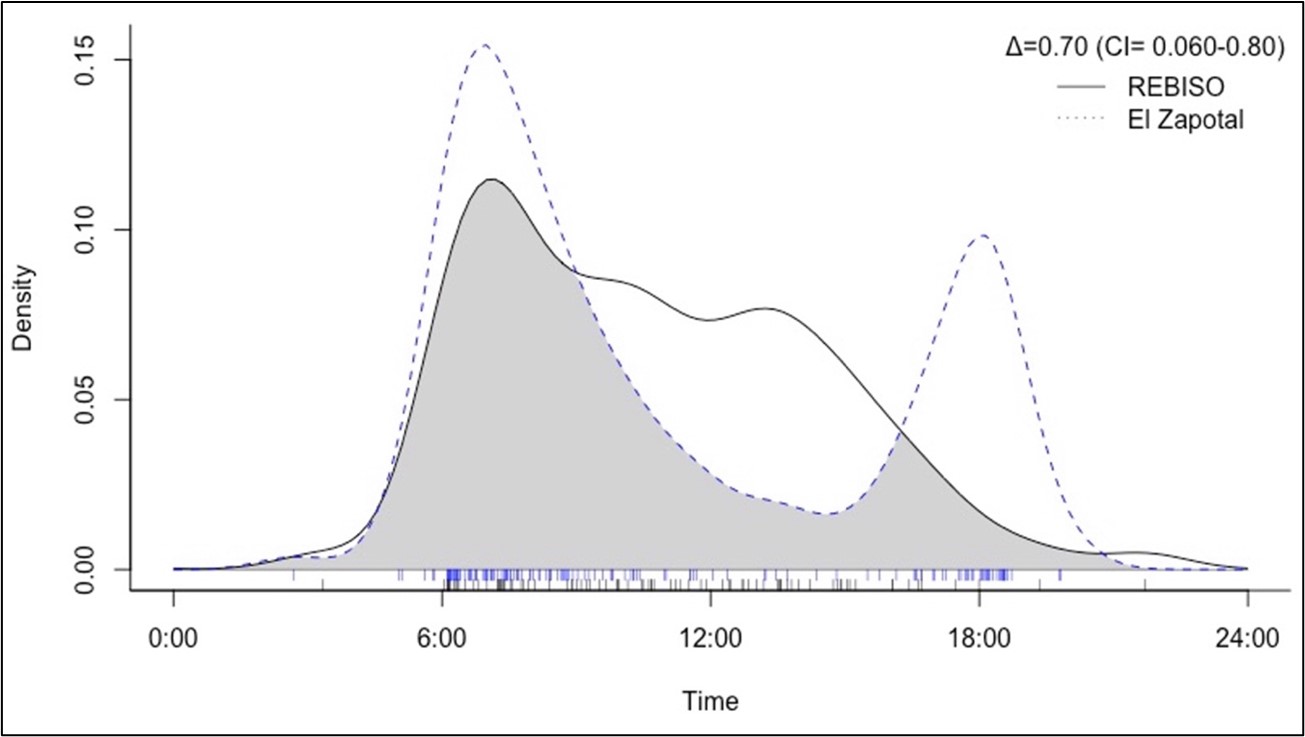
The activity patterns of Dasyprocta mexicana were compared in two contrasting Protected Natural Areas in Chiapas, Mexico: the Selva El Ocote Biosphere Reserve (REBISO), a wilderness area, and the El Zapotal Ecological and Recreational Center, an urban protected area with high visitor traffic. Camera traps were utilized for 102 days in REBISO (88 independent records) and 122 days in El Zapotal (140 independent records). Activity patterns were analyzed using the Overlap package in R, calculating the temporal overlap coefficient, and determining if there were significant differences between the activity periods of the two sites using the Mardia-Watson-Wheeler test. The species exhibited a diurnal pattern at both sites, with a high temporal overlap (Δ4 = 0.70; 95% CI = 0.60-0.80) but with significant differences (W = 13.643, P < 0.001). In REBISO, D. mexicana maintained continuous activity between 06:00 and 18:00 hours, with activity peaks between 06:00-08:00 and 13:00-14:00. At El Zapotal, a more pronounced bimodal pattern was observed, with peaks at dawn and dusk, significantly reducing activity during times of high human presence (09:00-16:00). The observed differences could be attributed to the influence of human presence, in addition to other factors such as habitat characteristics, presence of predators, and resource availability.
References
AMBIO S.C., CONANP. 2021. Monitoreo de la Cobertura vegetal en ANP's de los complejos selva lacandona y zoque para la formulación de estrategias en la reducción de la deforestación. México: AMBIO S.C.-CONANP-Global Forest Watch-World Resources Institute.
Barrueto M, Ford AT, Clevenger AP. 2014. Anthropogenic effects on activity patterns of wildlife at crossing structures. Ecosphere 5:1-19. https://doi.org/10.1890/es13-00382.1
Blašković S, Gomerčić T, Topličanec I, Sindičić M. 2022. Temporal overlap of human and apex predator activity on wildlife trails and forest roads. Journal of Vertebrate Biology 71:22029. https://doi.org/10.25225/jvb.22029
Borges-Zapata JY, Contreras‐Moreno FM, Serrano-Mac-Gregor I, Simá-Pantí DE, Mayor CY, Zúñiga-Morales JA, Duque-Moreno VD, Hernández-Pérez EL, López-Chan JA. 2020. Uso de bebederos artificiales por el sereque centroamericano (Dasyprocta punctata) en la reserva de la biosfera de Calakmul, México. Agro Productividad 13:1. https://doi.org/10.32854/agrop.vi0.1575
Borroto-Páez R. 2009. Invasive mammals in Cuba: an overview. Biological Invasions 11:2279-2290. https://doi.org/10.1007/s10530-008-9414-z
Botts RT, Eppert AA, Wiegman TJ, Rodriguez A, Blankenship SR, Asselin EM, Garley WM, Wagner AP, Ullrich SE, Allen GR, Mooring MS. 2020. Circadian activity patterns of mammalian predators and prey in Costa Rica. Journal of Mammalogy 101:1313-1331. https://doi.org/10.1093/jmammal/gyaa103
Carter N, Shrestha BK, Karki JB, Pradhan NMB, Liu J. 2012. Coexistence between wildlife and humans at fine spatial scales. Proceedings of the National Academy of Sciences 109:15360-15365. https://doi.org/10.1073/pnas.1210490109
Díaz‐Ruiz F, Caro J, Delibes‐Mateos M, Arroyo B, Ferreras P. 2015. Drivers of red fox (Vulpes vulpes) daily activity: prey availability, human disturbance or habitat structure? Journal of Zoology 298:128-138. https://doi.org/10.1111/jzo.12294
DOF (Diario Oficial de la Federación). 1982. Decreto por el que se establece la Zona de Protección Forestal y Fáunica la región conocida como Selva El Ocote, municipio de Ocozocoautla, Chiapas. México: Diario Oficial de la Federación.
Estrada J, Naranjo E. 1997. Ecología del Agutí Mexicano (Dasyprocta mexicana) en El Zapotal, Chiapas. San Cristóbal de Las Casas, México: El Colegio de la Frontera Sur.
Gallina S, González-Romero A. 2018. La conservación de mamíferos medianos en dos reservas ecológicas privadas de Veracruz, México. Revista Mexicana de Biodiversidad 89:4. https://doi.org/10.22201/ib.20078706e.2018.4.2476
IUCN. 2023. The IUCN Red List of Threatened Species. Version 2023-1.2. https://www.iucnredlist.org/. Accessed 15 December 2023.
Jorge MLSP, Peres CA. 2005. Population Density and Home Range Size of Red‐Rumped Agoutis (Dasyprocta leporina) Within and Outside a Natural Brazil Nut Stand in Southeastern Amazonia. Biotropica 37:317-321. https://doi.org/10.1111/j.1744-7429.2005.00041.x
Lambert TD, Kays R, Jansen PA, Aliaga-Rossel E, Wikelski M. 2009. Nocturnal activity by the primarily diurnal Central American agouti (Dasyprocta punctata) in relation to environmental conditions, resource abundance and predation risk. Journal of Tropical Ecology 25:211-215. https://doi.org/10.1017/s0266467408005804
Lira-Torres I, Briones-Salas M. 2011. Impacto de la ganadería extensiva y cacería de subsistencia sobre la abundancia relativa de mamíferos en la Selva Zoque, Oaxaca, México. Therya 2:217-244. https://doi.org/10.12933/therya-11-49
Lorenzo C, Bolaños-Citalán J, Sántiz E, Navarrete D. 2017. Diversidad y conservación de los mamíferos terrestres de Chiapas, México. Revista Mexicana de Biodiversidad 88:735-754. https://doi.org/10.1016/j.rmb.2017.06.003
Massara RL, De Oliveira Paschoal AM, Bailey LL, Doherty PF, De Frias Barreto M, Chiarello AG. 2018. Effect of humans and pumas on the temporal activity of ocelots in protected areas of Atlantic Forest. Mammalian Biology 92:86-93. https://doi.org/10.1016/j.mambio.2018.04.009
Meredith M, Ridout M. 2021. Package 'overlap': estimates of coefficient of overlapping for animal activity patterns. R package version 0.3.4. https://CRAN.R-project.org/package=overlap/
Mezhua-Velázquez MJ, Serna-Lagunes R, Torres-Cantú GB, Pérez-Gracida LD, Salazar-Ortiz J, Mora-Collado N. 2022. Diversidad de mamíferos medianos y grandes del Ejido Zomajapa, Zongolica, Veracruz, México: implicaciones de manejo. Ecosistemas y Recursos Agropecuarios 9:2. https://doi.org/10.19136/era.a9n2.3316
Mohd‐Azlan J. 2006. Mammal Diversity and Conservation in a Secondary Forest in Peninsular Malaysia. Biodiversity and Conservation 15:1013-1025. https://doi.org/10.1007/s10531-004-3953-0
Norris DR, Michalski F, Peres CA. 2010. Habitat patch size modulates terrestrial mammal activity patterns in Amazonian forest fragments. Journal of Mammalogy 91:551-560. https://doi.org/10.1644/09-mamm-a-199.1
Pérez-Irineo G, Santos-Moreno A. 2013. Riqueza de especies y gremios tróficos de mamíferos carnívoros en una selva alta del sureste de México. Therya 4:551-564. https://doi.org/10.12933/therya-13-157
Pérez-Flores J, Hernández-Pérez E, Weissenberger H, Carballo-Soto J, López-Castro EM, Ávila-Flores FJ. 2024. The effects of the decline in tourism during the COVID-19 lockdown on the wild mammal community in forest surrounding a theme park on the Mexican Caribbean. Journal for Nature Conservation 81:126693. https://doi.org/10.1016/j.jnc.2024.126693
Peral C, Landman M, Kerley GI. 2022. The inappropriate use of time‐to‐independence biases estimates of activity patterns of free‐ranging mammals derived from camera traps. Ecology and Evolution 12:10. https://doi.org/10.1002/ece3.9408
Pozo-Montuy G, Camargo-Sanabria AA, Cruz-Canuto I, Leal-Aguilar K, Mendoza E. 2019. Análisis espacial y temporal de la estructura de la comunidad de mamíferos medianos y grandes de la Reserva de la Biosfera Selva El Ocote, en el sureste mexicano. Revista Mexicana de Biodiversidad 90:0. https://doi.org/10.22201/ib.20078706e.2019.90.2731
R Core Team. 2022. R: A language and environment for statistical computing. Vienna, Austria: R Foundation for Statistical Computing. https://www.R-project.org/
Ríos-Solís JA, Flores-Martínez JJ, Sánchez-Cordero V, Lavariega MC. 2021. Diversity and activity patterns of medium- and large-sized terrestrial mammals at the Los Tuxtlas Biosphere Reserve, México. Therya 12:237-248. https://doi.org/10.12933/therya-21-1105
Roach N, Naylor L, Flore, S. 2024. Dasyprocta mexicana. The IUCN Red List of Threatened Species 2024:e.T6285A22198164. https://dx.doi.org/10.2305/IUCN.UK.2024-1.RLTS.T6285A22198164.en. Accessed on 16 May 2025.
Sánchez-Brenes RJ, Monge J. 2021. Períodos de actividad y dieta de Dasyprocta punctata (Gray, 1842) (Rodentia; Dasyproctidae) en agroecosistemas con café, San Ramón, Costa Rica. Acta Zoológica Mexicana 37:1-15. https://doi.org/10.21829/azm.2021.3712346
Sánchez‐Cordero V, Illoldi-Rangel P, Linaje M, Sarkar S, Peterson AT. 2005. Deforestation and extant distributions of Mexican endemic mammals. Biological Conservation 126:465-473. https://doi.org/10.1016/j.biocon.2005.06.022
Santos‐Moreno A, Pérez-Irineo G. 2013. Abundancia de tepezcuintle (Cuniculus paca) y relación de su presencia con la de competidores y depredadores en una selva tropical. Therya 4:89-98. https://doi.org/10.12933/therya-13-97
SEMAHN (Secretaría de Medio Ambiente e Historia Natural). 2017. Programa de Manejo del Área Natural Protegida Parque Estatal "Centro Ecológico y Recreativo El Zapotal". Tuxtla Gutiérrez, México: Gobierno del Estado de Chiapas.
SEMAHN (Secretaría de Medio Ambiente e Historia Natural). 2023. Celebra ZooMAT su aniversario 77. Boletín no. 1045. https://semahn.chiapas.gob.mx/portal/noticias/ver_noticia/1045. Accessed 10 October 2023.
SEMARNAT (Secretaría de Medio Ambiente y Recursos Naturales). 2001. Programa de Manejo Reserva de la Biosfera Selva El Ocote. México: SEMARNAT.
SEMARNAT (Secretaría de Medio Ambiente y Recursos Naturales). 2019. Modificación del anexo normativo III de la Norma Oficial Mexicana NOM-059-SEMARNAT-2010, Protección Ambiental. Especies Nativas de México de Flora y Fauna Silvestres. Categorías de Riesgo y Especificaciones para su Inclusión, Exclusión o Cambio. Lista de Especies en Riesgo. México: Diario Oficial de la Federación.
Suselbeek L, Emsens W, Hirsch BT, Kays R, Rowcliffe JM, Zamora‐Gutiérrez V, Jansen PA. 2014. Food acquisition and predator avoidance in a Neotropical rodent. Animal Behaviour 88:41-48. https://doi.org/10.1016/j.anbehav.2013.11.012
Telles-Ospina S, Quintero-López EE, Grajales-Suaza E. 2024. Patrones de actividad diaria de Dasyprocta punctata (Rodentia: Dasyproctidae) en sitios con y sin fuentes artificiales de alimento en la ciudad de Armenia, Quindío. Mammalogy Notes 10:440. https://doi.org/10.47603/mano.v10n2.440
Teta P, Reyes‐Amaya N. 2021. Uncovering species boundaries through qualitative and quantitative morphology in the genus Dasyprocta (Rodentia, Caviomorpha), with emphasis in D. punctata and D. variegata. Journal of Mammalogy 102:1548-1563. https://doi.org/10.1093/jmammal/gyab101
Wasserberg G, Kotler BP, Abramsky Z. 2006. The role of site, habitat, seasonality and competition in determining the nightly activity patterns of psammophilic gerbils in a centrifugally organized community. Oikos 112:573-579. https://doi.org/10.1111/j.0030-1299.2006.14302.x
Weyer NM, Fuller A, Haw A, Meyer LCR, Mitchell D, Picker MD, Rey B, Hetem RS. 2020. Increased Diurnal Activity Is Indicative of Energy Deficit in a Nocturnal Mammal, the Aardvark. Frontiers in Physiology 11. https://doi.org/10.3389/fphys.2020.00637

This work is licensed under a Creative Commons Attribution 4.0 International License.