Registros de Coendu mexicanus (Kerr, 1792)(Rodentia, Erethizontidae) en un monocultivo de palma y comentarios sobre sus amenazas en Chiapas, Mexico
Resumen
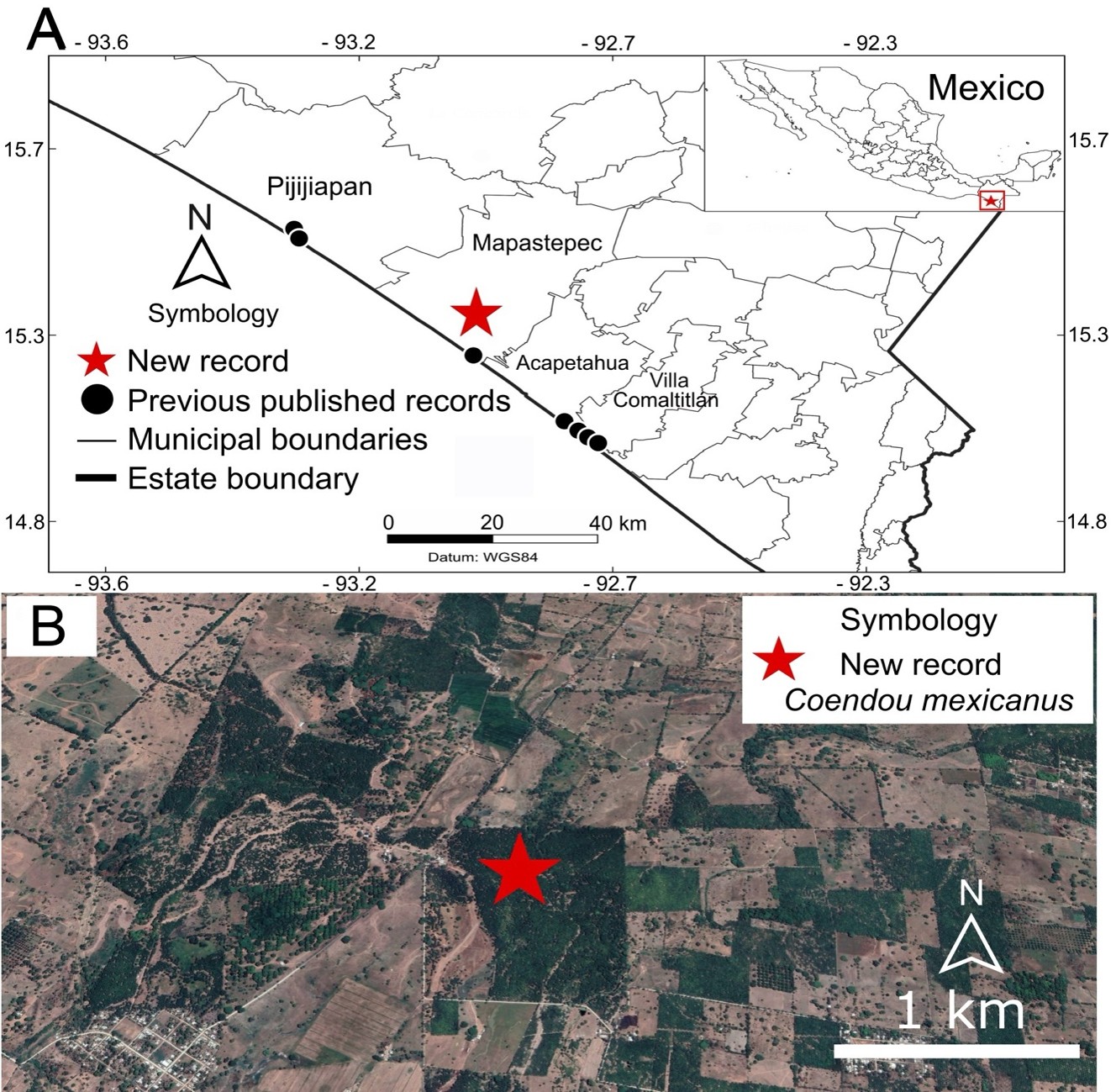
La biología del Puercoespín tropical, Coendou mexicanus, sigue siendo pobremente documentada, incluyendo su distribución y ecología. Reportamos una nueva observación directa de un juvenil de C. mexicanus en el municipio de Mapastepec, Chiapas, México, dentro de un monocultivo de palma de aceite y resaltamos las amenazas que enfrenta debido a la expansión de actividades agrícolas. La transformación de los bosques naturales en monocultivos reduce la disponibilidad de recursos para la especie, incrementando su vulnerabilidad a la fragmentación del hábitat. Es necesario implementar estrategias de manejo y conservación que consideren los impactos de la agricultura sobre la diversidad local.
Descargas
Citas
Batista-da-Silva JA, Barcellos SJA, Santori RT. 2019. Use of Elaeis guineensis (Arecales: Arecaceae) as shelter and food resource by Coendou spinosus (Rodentia: Erethizontidae) in a mangrove swamp. Oecologia Australis, 23(4), 1104-1108.
Briones-Salas M, Sánchez-Cordero V. 2004. Mamíferos. In: García-Mendoza AJ, Ordoñez MJ, Briones-Salas M, editors. Biodiversidad de Oaxaca. Instituto de Biología, Universidad Nacional Autónoma de México, Fondo Oaxaqueño para la Conservación de la Naturaleza. World Wildlife Fund, México. p. 423-447.
Chamberlain S, Barve V, Mcglinn D, Oldoni D, Desmet P, Geffert L, Ram K. 2025. rgbif: Interface to the Global Biodiversity Information Facility API. R package version 3.8.1. https://CRAN.R-project.org/package=rgbif
Cisneros-Palacios ME, Reyes-Macedo G, Méndez Á, Monroy G, Ramírez Calderón C. 2015. Noteworthy records of tropical porcupine Sphiggurus mexicanus (Erethizontidae) in Oaxaca, México. Therya 6(3):647-652. https://doi.org/10.12933/therya-15-287
Córdoba-Alfaro J. 2016. Presence and distribution of Sphiggurus mexicanus (Rodentia: Erethizontidae) for the South Pacific lowland of Costa Rica. Brenesia 85(86):72-74.
Estrada A, Coates‐Estrada R. 1985. A preliminary study of resource overlap between howling monkeys (Alouatta palliata) and other arboreal mammals in the tropical rain forest of Los Tuxtlas, Mexico. American Journal of Primatology 9(1):27-37. https://doi.org/10.1002/ajp.1350090104
Franquesa-Soler M, Ocampo-Saure F, Mora F, Andrade-Ponce GP, Andresen E. 2023. Socioecological assessment of mammal assemblages in small oil-palm plantations in a highly deforested region in Mexico. Tropical Conservation Science 16(1): https://doi.org/10.1177/194008292311699
GBIF. 2025. Global Biodiversity Information Facility occurrence download. https://doi.org/10.15468/dl.rmhrdg. Accessed on 01 January 2025
Google. 2025. Google Maps. https://maps.google.com/ Accessed on 11 March 2025
Hernandez-Hernandez JC, Chavez C. 2021. Inventory of medium-sized and large mammals in La Encrucijada Biosphere Reserve and Puerto Arista Estuarine System, Chiapas, Mexico. Check List 17(4):1155-1170. https://doi.org/10.15560/17.4.1155
Hidalgo-Mihart MG, González-Gallina A, Iglesias-Hernández JA, Mendoza-Cárdenas N, Pérez-Garduza F, Oliveras de Ita A, Chacón-Hernández A, Vázquez-Zúñiga O. 2022. Mammal use of canopy bridges along the Nuevo Xcan-Playa del Carmen highway, Quintana Roo, Mexico. Folia Primatologica 93(3-6):371-381. https://doi.org/10.1163/14219980-20210902
Lira-Torres I, Sánchez-Rojas G, Ojeda-Ramírez D, Gómez de Anda FR. 2014. New record of the Mexican hairy porcupine Sphiggurus mexicanus (Rodentia: Erethizontidae) in the eastern Sierra of Mexico. Therya 5(1):271-275. https://doi.org/10.12933/therya-14-158
Lorenzo C, Sántiz EC, Navarrete DA, Bolaños J. 2014. Causes and consequences of habitat change rates for the tropical porcupine Sphiggurus mexicanus in Oaxaca, Mexico: Implications for conservation. Revista de Biología Tropical 62(4):1481-1494.
Medellin R. 1994. Mammal diversity and conservation in the Selva Lacandona, Chiapas, Mexico. Conservation Biology 8(3):780-799. https://doi.org/10.1046/j.1523-1739.1994.08030780.x
Monterrubio-Rico TC, Ortega-Rodríguez JM, Mendoza-Cárdenas N, Cancino-Murillo R, Pérez-Arteaga A. 2010. Distributional and ecological records of the Mexican hairy dwarf porcupine (Sphiggurus mexicanus) from Michoacán, Mexico. The Southwestern Naturalist 55(1):139-142. https://doi.org/10.1894/CLG-27.1
Osorio-Rodriguez AN, Vázquez-Arroyo E, Almazán-Catalán JA, Farias DU, Juárez-Agis A, López LAG. 2021. Current distribution of the Mexican hairy dwarf porcupine, Sphiggurus mexicanus, in Guerrero, México. Therya Notes 2:65-72. https://doi.org/10.12933/therya_notes-21-37
Pérez-Irineo G, Santos-Moreno A. 2012. Diversity of large and medium-sized land mammals in a subcaducifolious tropical forest of northeastern Oaxaca, Mexico. Revista Mexicana de Biodiversidad 83(1):164-169.
Posit Team. 2025. RStudio: Integrated development environment for R. Posit Software. http://www.posit.co/
QGIS Development Team. 2024. QGIS Geographic Information System. Open source geospatial foundation project. http://qgis.osgeo.org
Ramírez-Bravo OE. 2012. New records of the Mexican hairy porcupine (Coendou mexicanus) and tamandua (Tamandua mexicana) in Puebla, Central Mexico. Western North American Naturalist 72(1):93-95. https://doi.org/10.3398/064.072.0111
Ramírez-Chaves HE, Torres-Martínez MM, Henao-Osorio JJ, Osbahr K, Concha-Osbahr C, Passos FC, Noguera-Urbano, E. 2022. Distribution update, male genitalia, natural history, and conservation of the stump-tailed porcupine Coendou rufescens in South America. Mammalia, 86(2):160-170.
Rzedowski J. 2006. Vegetación de México. 1ra. edición digital, Comisión Nacional para el Conocimiento y Uso de la Biodiversidad. México. 504 p.
Redford K, Eisenberg J. 1992. Mammals of the Neotropics: The Southern Cone. Chicago and London. University of Chicago Press.
Reid FA. 2009. A field guide to the mammals of Central America and Southeast Mexico. 2nd ed. New York, USA. Oxford University Press.
Riechers-Pérez A. 2004. Análisis mastofaunístico de la zona sujeta a conservación ecológica Laguna Bélgica, Chiapas, México. Anales del Instituto de Biología. Serie Zoología 75(2):363-382.
Roslan SNL, Anwar NI, Yusof MA, Talibe H, Farinordin FA, Izam NAM, Abdullah NA, Ab Wahab MF. 2025. Inventory of non-volant small mammals in the mixed-land use habitats at Pusat Penyelidikan Pertanian Tun Razak, Jerantut, Pahang. Malaysian Journal of Fundamental and Applied Sciences 21(1):1669-1677. https://doi.org/10.11113/mjfas.v21n1.3882
Vázquez E, Reid F, Cuarón AD. 2016. Coendou mexicanus. The IUCN Red List of Threatened Species 2016: e.T20629A22214103. https://dx.doi.org/10.2305/IUCN.UK.2016-2.RLTS.T20629A22214103.en
Wainwright M. 2002. The natural history of Costa Rican mammals. Zona Tropical. San José, Costa Rica.
Wilson D, Reeder D. 2005. Mammal species of the world: A taxonomic and geographic reference. Baltimore: Johns Hopkins University Press.
Yue S, Brodie JF, Zipkin EF, Bernard H. 2015. Oil palm plantations fail to support mammal diversity. Ecological applications 25(8) https://doi.org/10.1890/14-1928.1
Derechos de autor 2026 Angel I. Contreras-Calvario , Erika García-Casimiro, César Camilo Julián Caballero

Esta obra está bajo licencia internacional Creative Commons Reconocimiento 4.0.
Aceptado 2025-10-11
Publicado 2026-06-25