
Keywords
How to Cite
Accepted 2026-05-17
Published 2026-09-21




Abstract
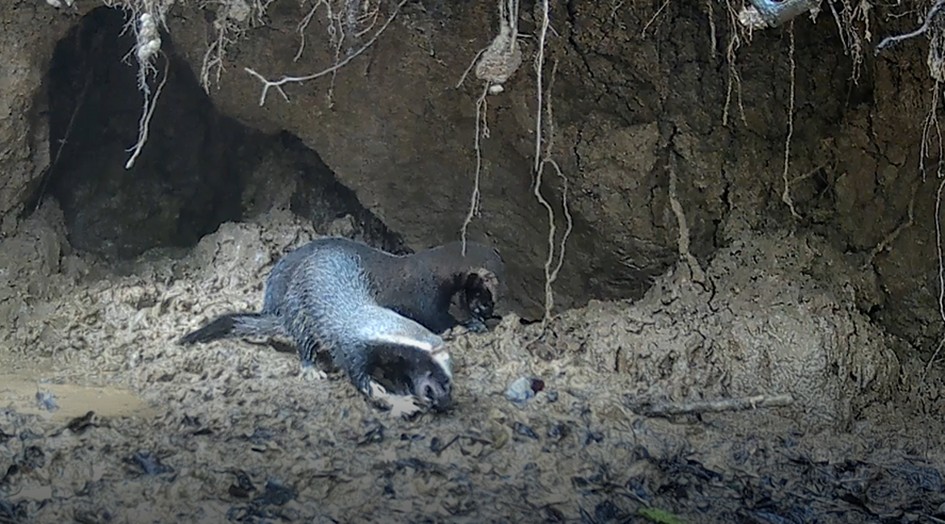
We report the first documented predation of invertebrates by greater grisons (Galictis vittata) based on camera-trap footage from a mineral lick in Southeastern Peru. Two adult individuals were recorded capturing and consuming large arachnids, likely whip spiders (Amblypygi), from a natural cavity. One grison visibly removed and discarded part of the prey prior to ingestion, suggesting selective handling to reduce risk from defensive structures. These observations extend the known cavity-focused foraging behavior of G. vittata and indicate that amblypygids may represent an underreported but regular prey item in tropical habitats.
References
Bisbal FJ. 1986. Food habits of some Neotropical carnivores in Venezuela (Mammalia, Carnivora). Mammalia 50: 329–339. https://doi.org/10.1515/mamm.1986.50.3.329
Bornholdt R, Helgen KM, Koepfli KP, Oliveira L, Lucherini M, Eizirik E. 2013. Taxonomic revision of the genus Galictis (Carnivora: Mustelidae): species delimitation, morphological diagnosis, and refined mapping of geographical distribution. Zoological Journal of the Linnean Society 167: 449–472. https://doi.org/10.1111/j.1096-3642.2012.00859.x
Champagne P, Crnobrna B, Kazmi M, Payne C. 2024. Lowland interior-forest stream habitat of Ga-lictis vittata (Carnivora: Mustelidae) on the Las Piedras tributary, southeastern Peru. Mammalogy Notes 10: 408–408. https://doi.org/10.47603/mano.v10n2.408
Cintra R. 1988. Bufo marinus (marine toad) predation. Herpetological Review 19: 82.
Dalquest WW, Roberts JH. 1951. Behavior of young grisons in captivity. The American Midland Natu-ralist 46: 359–366. https://doi.org/10.2307/2421983
Hidalgo-Mihart MG, Juárez-López R, Contreras-Moreno F, de la Cruz AJ, López-Luna MA. Bravata-de la Cruz Y. 2018. Greater grison (Galictis vittata) hunts a Central American indigo snake (Drymar-chon melanurus) in southeastern Mexico. The Southwestern Naturalist 63: 197–199. https://doi.org/10.1894/0038-4909-63-3-197
Janson CH. Emmons LH. 1990. Ecological structure of the non-flying mammal community at Cocha Cashu Biological Station, Manu National Park, Peru. In: Gentry AH, editor. New Haven: Yale Univer-sity Press. p. 314–338.
Kaufmann JH. Kaufmann A. 1965. Observations of the behavior of tayras and grisons. Zeitschrift für Säugetierkunde 30: 146–155.
Kays RW. 1996. Comments on the behavior of a grison (Galictis vittata) hunting an agouti (Dasy-procta punctata). Small Carnivore Conservation 15: 5.
Oliveira TG. 2009. Notes on the distribution, status, and research priorities of little-known small carnivores in Brazil. Small Carnivore Conservation 41: 22–24.
Sunquist ME. Sunquist F. Daneke DE. 1989. Ecological separation in a Venezuelan llanos carnivore community. In: Redford KH, Eisenberg JF, editors. Gainesville: Sandhill Crane Press. p. 197–232.
Whitworth A. 2023. Greater grison (Galictis vittata) predation events upon paca (Cuniculus paca) suggest a cavity-targeted hunting strategy. Neotropical Biodiversity 9: 56–58. https://doi.org/10.1080/23766808.2023.2185175
Whitworth A, Beirne C, Basto A, Flatt E, Tobler M, Powell G, Terborgh J, Forsyth A. 2022. Disappear-ance of an ecosystem engineer, the white-lipped peccary (Tayassu pecari), leads to density com-pensation and ecological release. Oecologia 199: 937–949. https://doi.org/10.1007/s00442-022-05233-5
Weygoldt P. 2000. Whip spiders (Chelicerata: Amblypygi): Their biology, morphology and systemat-ics. Stenstrup: Apollo Books.
Yensen E, Tarifa T. 2003. Galictis vittata. Mammalian Species: 727: 1–8. https://doi.org/10.1644/0.727.1

This work is licensed under a Creative Commons Attribution 4.0 International License.