

Keywords
Mammal Vocalization
Camera Trap
Tropical Forest
Perú
How to Cite
Accepted 2026-03-07
Published 2026-08-11
Abstract
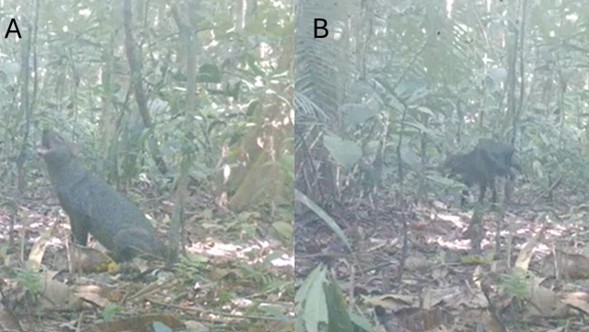
The short-eared dog (Atelocynus microtis) is one of South America's rarest carnivores, with wild vocalizations never documented. We report the first wild vocalization of this Amazonian endemic, captured via camera trap in southeastern Peru on 8 May 2025. An adult male produced a distinctive bird-like howling sequence consisting of repetitive, high-pitched calls that escalated in both pitch and volume, followed by scent-marking behavior. We hypothesize this represents a long-distance communication call adapted for dense forest environments, where brief, high-pitched bursts may penetrate vegetation more effectively than sustained howls while avoiding detection by predators such as jaguars. All audio recordings have been deposited in an open-access repository to facilitate comparative studies to support development of bioacoustic monitoring protocols for this understudied species.
References
Bahaa‐el‐din L, Henschel P, Butynski TM, Macdonald DW, Mills D, Slotow R, Hunter L. The African golden cat Caracal aurata: Africa’s least‐known felid. Mammal Review. 2015;45(1):63–77. doi:10.1111/mam.12033
Berta A. Atelocynus microtis. Mammalian Species. 1986;(256):1–3.
Bischof R, Ali H, Kabir M, Hameed S, Nawaz MA. Being the underdog: an elusive small carnivore uses space with prey and time without enemies. Journal of Zoology. 2014;293(1):40–48. doi:10.1111/jzo.12100
Browning E, Gibb R, Glover-Kapfer P, Jones KE. Passive acoustic monitoring in ecology and conservation. WWF-UK; 2017. https://repository.oceanbestpractices.org/handle/11329/1370. doi:10.25607/OBP-876
Carvalho JCD, Souza FF, Kastelic JP, Ferreira JCP. Reproduction in South American wild canids—A review. Frontiers in Veterinary Science. 2022;9:986030. doi:10.3389/fvets.2022.986030
Champagne PS, Oliveira HFM, Payne CJ, Pitman RL. Endemic and elusive trophic interactions: The first comprehensive description of the diet of short-eared dogs (Atelocynus microtis) in Amazon rainforests. Food Webs. 2024;41:e00366. doi:10.1016/j.fooweb.2024.e00366
Champagne P. LAS PIEDRAS BIODIVERSITY STATION. Ecotropica, 2024;26(1/2). doi: 10.30427/ecotrop202403
Crnobrna B, Champagne PS, Williams HF, Turner H, Pisco GP. Occurrence dataset of reptiles and amphibians from two old-growth forest localities along the Las Piedras River, Tambopata Province, Peru. Biodiversity Data Journal. 2025;13:e154136. doi:10.3897/BDJ.13.e154136.
Emmons L, Whitney BM, Ross DL, Barker MA, Budney GF. Sounds of neotropical rainforest mammals. Ithaca, NY: Cornell Laboratory of Ornithology, Library of Natural Sounds; 1997.
Gibb R, Browning E, Glover‐Kapfer P, Jones KE. Emerging opportunities and challenges for passive acoustics in ecological assessment and monitoring Börger L, editor. Methods in Ecology and Evolution. 2019;10(2):169–185. doi:10.1111/2041-210X.13101
Hearn AJ, Ross J, Bernard H, Bakar SA, Hunter LTB, Macdonald DW. The First Estimates of Marbled Cat Pardofelis marmorata Population Density from Bornean Primary and Selectively Logged Forest Murphy WJ, editor. PLOS ONE. 2016;11(3):e0151046. doi:10.1371/journal.pone.0151046
Hearn AJ, Ross J, Bernard H, Bakar SA, Goossens B, Hunter LTB, Macdonald DW. Responses of Sunda clouded leopard Neofelis diardi population density to anthropogenic disturbance: refining estimates of its conservation status in Sabah. Oryx. 2019;53(4):643–653. doi:10.1017/S0030605317001065
Hershkovitz Philip. On the South American small-eared zorro Atelocynus microtis Sclater (Canidae). [Chicago]: Chicago Natural History Museum,; 1961. http://www.biodiversitylibrary.org/bibliography/5457. doi:10.5962/bhl.title.5457
Kelly MJ, Holub EL. Camera Trapping of Carnivores: Trap Success Among Camera Types and Across Species, and Habitat Selection by Species, on Salt Pond Mountain, Giles County, Virginia. Northeastern Naturalist. 2008;15(2):249–262. doi:10.1656/1092-6194(2008)15[249:CTOCTS]2.0.CO;2
Kershenbaum A, Akçay Ç, Babu‐Saheer L, Barnhill A, Best P, Cauzinille J, Clink D, Dassow A, Dufourq E, Growcott J, et al. Automatic detection for bioacoustic research: a practical guide from and for biologists and computer scientists. Biological Reviews. 2025;100(2):620–646. doi:10.1111/brv.13155
Laiolo P. The emerging significance of bioacoustics in animal species conservation. Biological Conservation. 2010;143(7):1635–1645. doi:10.1016/j.biocon.2010.03.025
Larsen HL, Pertoldi C, Madsen N, Randi E, Stronen AV, Root-Gutteridge H, Pagh S. Bioacoustic Detection of Wolves: Identifying Subspecies and Individuals by Howls. Animals. 2022;12(5):631. doi:10.3390/ani12050631
Leite-Pitman MRP, Champagne P, Ferreira E. Predation of Atelocynus microtis and Speothos venaticus (Carnivora: Canidae) by Boa constrictor (Squamata: Boidae) in Southwestern Brazil and Southeastern Peru. Mammalogy Notes. 2023;9(1):326. doi:10.47603/mano.v9n1.326
Leite-Pitman MRP, Williams R. Atelocynus microtis. The IUCN Red List of Threatened Species 2011: e. T6924A12814890. 2011.
The incredible amazon roaring dog. Los Amigos Biological Station, Madre de Dios, Peru; 2014. https://www.youtube.com/watch?v=kmLDl8GVxS0
Michalski F. The bush dog Speothos venaticus and short-eared dog Atelocynus microtis in a fragmented landscape in southern Amazonia. Oryx. 2010;44(2):300–303. doi:10.1017/S0030605309990871
O’Donnell H. First record of a short-eared dog scavenging on an armadillo carcass. 2020;22(7):25–28.
O'Donnell H, Champagne P. Vocalization of a wild, adult male Atelocynus microtis from the Las Piedras River, Madre de Dios, Peru. figshare. Media. 2025 https://doi.org/10.6084/m9.figshare.30049936
Payne CJ, Champagne PS, O’Donnell H, Lange LR, Rushford C, Rosolie P, Rosenzweig D. High mammalian diversity on the Las Piedras River tributary of Madre de Dios, Peru: An annotated list of species including comments on biogeography and regional conservation. Check List. 2024;20(1):152–183. doi:10.15560/20.1.152
Rocha DG, De Barros Ferraz KMPM, Gonçalves L, Tan CKW, Lemos FG, Ortiz C, Peres CA, Negrões N, Antunes AP, Rohe F, et al. Wild dogs at stake: deforestation threatens the only Amazon endemic canid, the short-eared dog (Atelocynus microtis). Royal Society Open Science. 2020;7(4):190717. doi:10.1098/rsos.190717
Ross S, O’Connell D, Deichmann J, Desjonquères C, Gasc A, Phillips J, Sethi S, Wood C, Burivalova Z. Passive acoustic monitoring provides a fresh perspective on fundamental ecological questions. 2023 [accessed 2025 Sep 4]. https://www.repository.cam.ac.uk/handle/1810/346288. doi:10.17863/CAM.93709
Sadhukhan S, Root-Gutteridge H, Habib B. Identifying unknown Indian wolves by their distinctive howls: its potential as a non-invasive survey method. Scientific Reports. 2021;11(1):7309. doi:10.1038/s41598-021-86718-w
Wood CM, Klinck H, Gustafson M, Keane JJ, Sawyer SC, Gutiérrez RJ, Peery MZ. Using the ecological significance of animal vocalizations to improve inference in acoustic monitoring programs. Conservation Biology. 2021;35(1):336–345. doi:10.1111/cobi.13516

This work is licensed under a Creative Commons Attribution 4.0 International License.