
Keywords
How to Cite
Accepted 2025-12-21
Published 2026-08-11




Abstract
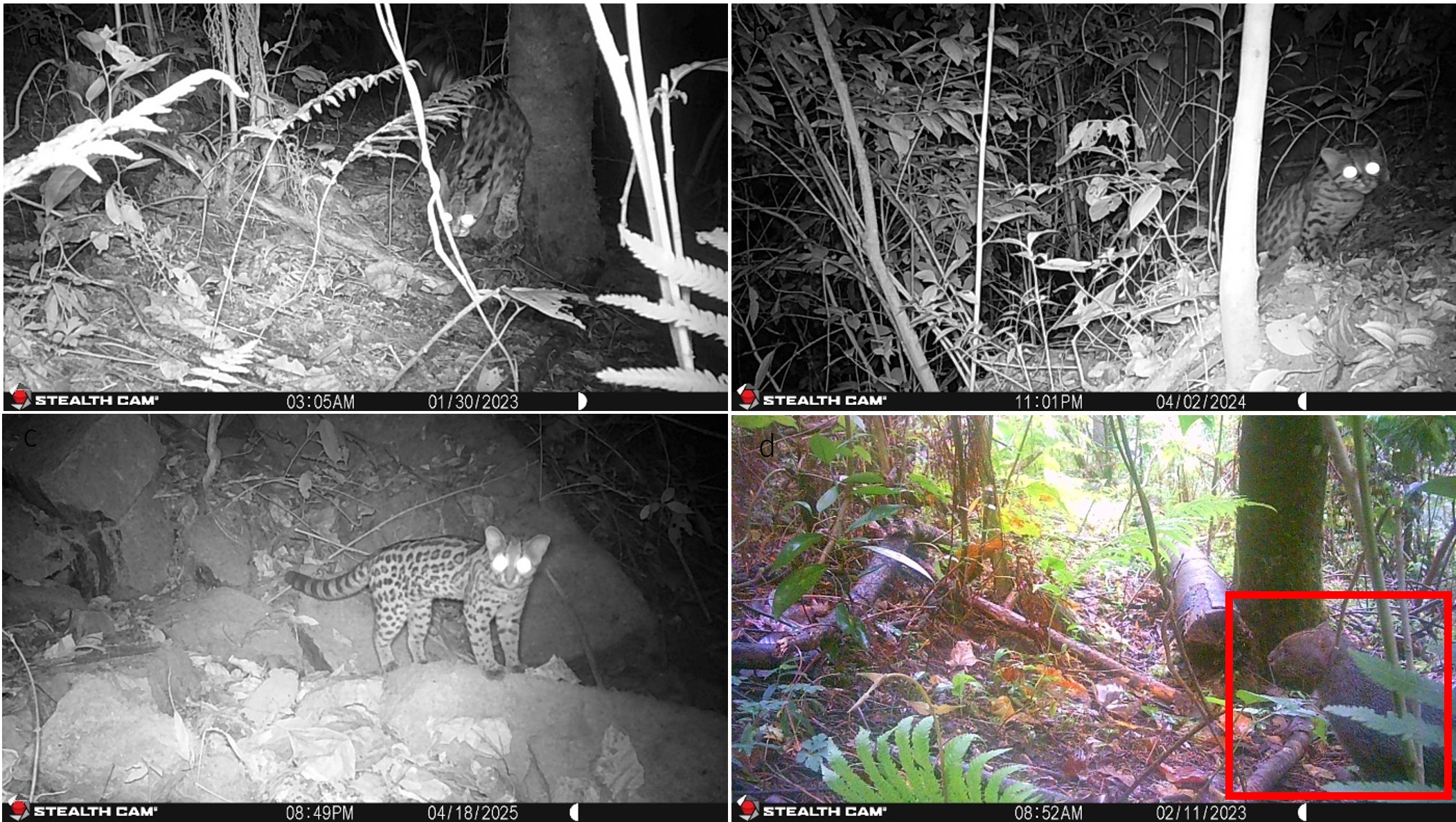
In Mexico, Leopardus wiedii and Herpailurus yagouaroundi are classified as endangered species; however, they are among the least studied carnivorous mammals. The purpose of this article is to report additional records of L. wiedii and H. yagouaroundi in the Sierra Nororiental de Puebla. From January to March 2023, April to June 2024 and April to June 2025, ten camera trap stations were installed at sites where traces of wild mammals were detected. Additionally, a map was created that includes records from international databases and articles published in Mexico. Three independent records of L. wiedii were obtained in shade-grown coffee plantations. In addition, one record of H. yagouaroundi was obtained inside a shade-grown coffee plantation. There are few documented records of the presence of these species in much of the state of Puebla. The records were obtained in a shade-grown coffee plantation, considered to be an agricultural activity with less impact on biodiversity, which has probably allowed the presence of species such as L. wiedii and H. yagouaroundi. Their record in the north of the state could indicate that this region functions as a biological corridor for these species.
References
Almazán-Catalán JA, Sánchez-Hernández C, Fernando Ruíz-Gutiérrez F, Romero-Almaraz ML, Taboada-Salgado A, Beltrán-Sánchez E, Sánchez-Vázquez L. 2013. Registros adicionales de felinos del estado de Guerrero, México. Revista Mexicana de Biodiversidad 84(1):347-359. https://doi.org/10.7550/rmb.23087
Aranda M, Valenzuela-Galván D. 2015. Registro notable de margay (Leopardus wiedii) en el bosque mesófilo de montaña de Morelos, México. Revista Mexicana de Biodiversidad 86:1110-1112. https://doi.org/10.1016/j.rmb.2015.09.015
Aranda M. 2005a. Leopardus wiedii (Schinz, 1821): Tigrillo. In: Ceballos G, Oliva G, editors. Los Mamíferos Silvestres de México. Fondo de Cultura Económica, Comisión Nacional para el Conocimiento y Uso de la Biodiversidad. p. 361-362.
Aranda M. 2005b. Herpailurus yagouaroundi (Schreber, 1777): Yaguarundi. In: Ceballos G, Oliva G, editors. Los Mamíferos Silvestres de México. Fondo de Cultura Económica, Comisión Nacional para el Conocimiento y Uso de la Biodiversidad. p. 358-361
Ávila-Nájera DM, Gómez-Ortíz Y, Valdés P. 2024. Margay: Wild Furbearer Management and Conservation in North America. In: Hiller TL, Applegate LD, Bluett RD, Frey SN, Gese MG, Organ JF, editors. Montana, USA. Wildlife Ecology Institute. p 39.1-39.15.
Botello F, Illoldi-Rangel P, Linaje M, Sánchez-Cordero V. 2006. Primer registro del tigrillo (Leopardus wiedii, Schinz 1821) y del gato montés (Lynx rufus, Kerr 1792) en la Reserva de la Biósfera de Tehuacán-Cuicatlán, Oaxaca, México. Acta Zoológica Mexicana (n.s.) 22(1): 135-139. https://doi.org/10.21829/azm.2006.2211969
Brodie J. 2009. Is research effort allocated efficiently for Conservation? Felidae as a global case study. Biodiversity and Conservation 18(11):2927-2939. https://doi.org/10.1007/s10531-009-9617-3
Caso A (2013). Spatial Differences and Local Avoidance of Ocelot (Leopardus pardalis) and Jaguarundi (Puma yagouaroundi) in Northeast Mexico (Doctoral thesis). Texas A&M University, Kingsville, Texas, USA.
Charré-Medellín JP, Monterrubio-Rico TC, Guido-Lemus D, Mendoza E. 2015. Patrones de distribución de felinos silvestres (Carnivora: Felidae) en el trópico seco del Centro-Occidente de México. Revista de Biología Tropical 63(3):783-797. https://doi.org/10.15517/rbt.v63i3.15408
Charré-Medellín JF, Sánchez-Cordero V, Magaña-Cota G, Álvarez-Jara M, Botello F. 2012. Jaguaroundi (Puma yagouaroundi) in Guanajuato, Mexico. The Southwestern Naturalist 57:117-118. https://doi.org/10.1894/0038-4909-57.1.117
Coronado-Quibrera WP, Olmos-Oropeza G, Bender LC, Rosas-Rosas OC, Palacio-Núñez J, Tarango-Arámbula LA, Herrera-Haro JG. 2019. Adaptabilidad del amenazado Jaguarundi (Herpailurus yagouaroundi Schreber, 1777) a ambientes antropizados en San Luis Potosí, México. Acta Zoológica Mexicana 35:e3502210. https://doi.org/10.21829/azm.2019.3502210
Cruz-Lara LC, Lorenzo C, Soto L, Naranjo E, Ramírez-Marcial N. 2004. Diversidad de mamíferos en cafetales y selva mediana de las cañadas de la Selva Lacandona, Chiapas, México. Acta Zoológica Mexicana 20:63-81. https://doi.org/10.21829/azm.2004.2011999
Dueñas-López G, Rosas-Rosas OC, Chapa-Vargas L, Bender LC, Tarango- Arámbula LA, Martínez-Montoya JF, Alcántara-Carbajal JL. 2015. Connectivity among jaguar populations in the Sierra Madre Oriental, México. Therya 7:449-468. https://doi.org/10.12933/therya-15-257
Escobar-Anleu IB, Soto-Shoender JR, Rivas-Romero AJ, Montes N. 2023. ¿Más árboles con su café? Diversidad y asociaciones de hábitat de mamíferos terrestres medianos y grandes en plantaciones de café bajo sombra en el altiplano de Guatemala. Acta Zoológica Mexicana (nueva serie) 39:1-20. https://doi.org/10.21829/azm.2023.3912570
Evangelista-Oliva V, López Blanco J, Caballero Nieto J, Martínez Alfaro MA. 2010. Patrones espaciales de cambio de cobertura y uso del suelo en el área cafetalera de la sierra norte de Puebla. Investigaciones Geográficas 72:23-38.
Farías V, Téllez O, Botello F, Hernández O, Berruecos J, Olivares SJ, Hernández JC. 2015. Primeros registros de 4 especies de felinos en el sur de Puebla, México. Revista Mexicana de Biodiversidad 86:1065-1071. https://doi.org/10.1016/j.rmb.2015.06.014
Gallina S, Mandujano S, González-Romero A. 1996. Conservation of mammalian biodiversity in coffee plantations of Central Veracruz, México. Agroforestry Systems 33: 13-27. https://doi.org/10.1007/BF00122886
Giordano A. 2016. Ecology and status of the jaguarundi Puma yagouaroundi: a synthesis of existing knowledge. Mammal Review 46:30-43. https://doi.org/10.1111/mam.12051
Global Biodiversity Information Facility (GBIF). 2025. Free and open access to biodiversity data https://www.gbif.org/. Consultado el 10 de agosto 2025.
Gonzáles-Casas IA. 2023. Distribución espacial y horarios de actividad de felinos en relación con sus presas en El Carmen, Sinaloa (Master's thesis). Posgrado en Ciencias Biológicas, Universidad Nacional Autónoma de México.
Greenberg R, Bichier P, Cruz A, Reitsma R. 1997. Bird populations in shade and sun coffee plantations in Central Guatemala. Conservation Biology 11:448-459. https://doi.org/10.1046/j.1523-1739.1997.95464.x.
Hernández-Hernández JC, Ramírez-Morales JL, Cobos-Silva J. 2022. Registros recientes del grisón (Galictis vittata) y el tigrillo (Leopardus wiedii) en la Sierra Nororiental de Puebla, México. Revista Mexicana de Mastozoología (Nueva Época) 12:49-54. https://doi.org/10.22201/ie.20074484e.2022.12.1.337
Hernández-Reyes E. Ramírez-Bravo O, Hernández Talancón G. 2017. Patrones de cacería de mamíferos en la Sierra Norte de Puebla. Acta Zoológica Mexicana 33(3):421-430.
Horn PE, Pereira MJR, Trigo TC, Eizirik E, Tirelli FP. 2020. Margay (Leopardus wiedii) in the south-ernmost Atlantic Forest: density and activity patterns under different levels of anthropogenic disturbance. PLoS One 15:1-25. https://doi.org/10.1371/journal.pone.0232013
Instituto Nacional de Estadística y Geografía (INEGI). 2005. Guía para la interpretación de cartografía. Climatológica. Instituto Nacional de Estadística y Geografía, México. https://www.inegi.org.mx/app/biblioteca/ficha.html?upc=702825231781. Consultado el 8 de septiembre 2025.
Jesús-Espinosa D, Contreras-Moreno FM, Sánchez-Pinzón KG. 2024. Entre sombras y selvas: el enigmático selvas: el enigmático jaguarundi. Therya ixmana 3(3):109-110. https://doi.org/ 10.12933/therya_ixmana-24-515.
Moguel P, Toledo VM. 1999. Biodiversity conservation in traditional coffee systems of Mexico. Conservation Biology 13:11-21. https://doi.org/10.1046/j.1523-1739.1999.97153.x
Monterrubio-Rico TC, Charré-Medellín JF, Zavala-Paramo MG, Cano-Camacho H, Pureco-Rivera MQ, Leon-Paniagua L. 2012. Evidencias fotográfica, biológica y genética de la presencia actual de jaguaroundi (Puma yagouaroundi) en Michoacán, México. Revista Mexicana de Biodiversidad 83:825-833. https://doi.org/10.7550/rmb.28663
Monroy-Vilchis O, Sánchez O, Urios V. 2011. Consumption of an adult Puma yagouaroundi (Felidae) by the snake Boa constrictor (Boidae) in central Mexico. Revista Mexicana de Biodiversidad 82:319-321. DOI: https://doi.org/10.22201/ib.20078706e.2011.1.372
Ordóñez-Prado C, Fuentes López ME, Guerra de la Cruz V, Ortega Vázquez G, Álvarez Muñoz M. 2023. Diversidad de mamíferos medianos y grandes del Sitio Experimental Las Margaritas, Sierra Nororiental de Puebla. Revista Mexicana de Ciencias Forestales 14(78):87-116. https://doi.org/10.29298/rmcf.v14i78.1386
Pech-Canché JM, Jesús-Téllez EV, Serrano A. 2022. Nuevos registros de Puma yagouaroundi (Carnivora: Felidae) en zonas periurbanas de Tuxpan, Veracruz, México. Mammalogy Notes 8(2):289. https://doi.org/10.47603/mano.v8n2.289
Ramírez-Bravo OE, Hernández-Santin L. 2016. Carnivores (Mammalia) from areas of Nearctic-Neotropical transition in Puebla, central Mexico: Presence, distribution, and conservation. Check List 12:1833. https://doi.org/10.15560/12.1.1833
Ramírez-Bravo OE. 2010. Notes on Puma (Puma concolor), Lynx (Lynx rufus), Margay (Leopardus wiedii) and Jaguarundi (Puma yagouaroundi) distribution in Puebla, Central Mexico. Wild Felid Monitor 3(1):20.
Ramírez-Pulido J, González-Ruiz N, Genoways HH. 2005. Carnivores from the mexican state of Puebla: distribution, taxonomy and conservation. Mastozoología Neotropical 12:37-52.
Reid F. 1997. A field guide to the mammals of Central America and southeast México. Oxford University Press, New York.
Secretaria de Medio Ambiente y Recursos Naturales (SEMARNAT). 2010. Norma Oficial Mexicana NOM-059-SEMARNAT-2010, Protección ambiental-Especies nativas de México de flora y fauna silvestres-Categorías de riesgo y especificaciones para su inclusión, exclusión o cambio-Lista de especies en riesgo. Secretaría del Medio Ambiente y Recursos Naturales. México. 30 de diciembre de 2010. México City, México. https://www.gob.mx/profepa/documentos/norma-oficial-mexicana-nom-059-semarnat-2010. Accesed on 15 July 2025.
Silverio-Polo L, Ramírez-Bravo OE. 2014. Registro de la presencia de mamíferos medianos en dos zonas del municipio de Cuetzalan, en la Sierra Norte de Puebla. Therya 5(3):855-860.
Tobler MW, Carrillo-Percastegui SE, Pitman RL, Mares R, Powell G. 2008. An evaluation of camera traps for inventorying large‐and medium‐sized terrestrial rainforest mammals. Animal Conservation 11:169-178. https://doi.org/10.1111/j.1469-1795.2008.00169.x
Urbano-Vidales G, Sánchez-Herrera O, Téllez-Girón G, Medellín RA. 1987. Additional Records of Mexican Mammals. The Southwestern Naturalist 32(1):134-137. https://doi.org/10.2307/3672020
Valenzuela-Galván D, de León-Ibarra A, Lavalle-Sánchez A, Orozco-Lugo L, Chávez C. 2013. The margay Leopardus wiedii and bobcat Lynx rufus from the dry forest of Southern Morelos, Mexico. The Southwestern Naturalist. 58:118-120. https://doi.org/10.1894/0038-4909-58.1.118

This work is licensed under a Creative Commons Attribution 4.0 International License.