
Keywords
Predation
urban fauna
mesocarnivores
procionids
How to Cite
Accepted 2024-12-23
Published 2025-05-20




Abstract
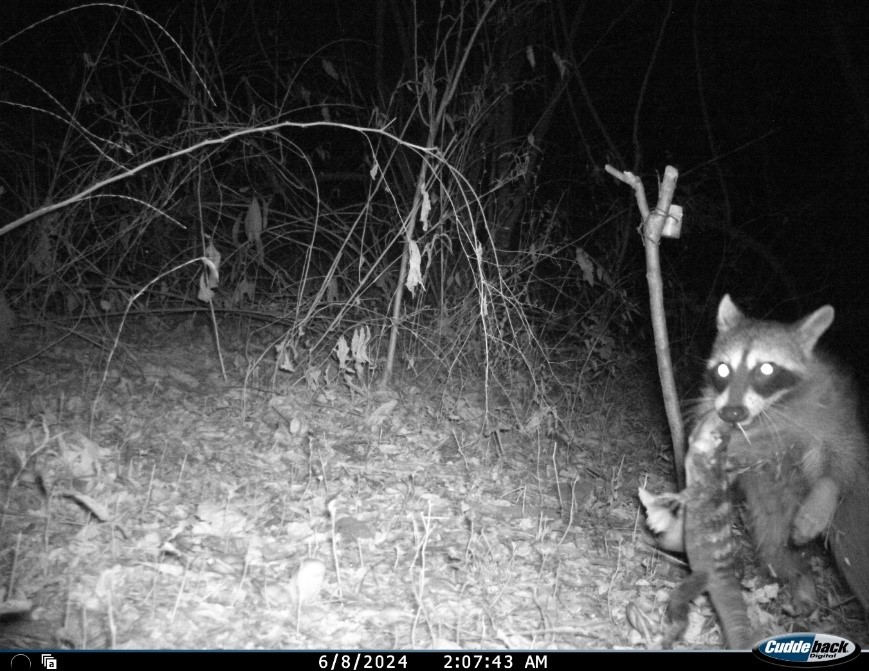
The northern raccoon (Procyon lotor) has a broad diet that includes plant matter, invertebrates, small vertebrates, and occasionally grains. Using camera traps, we documented for the first time the predation of the Mexican spiny-tailed iguana (Ctenosaura pectinata) by a northern raccoon in an urban protected natural area in western Mexico. This finding is significant as C. pectinata is a threatened species in Mexico and is listed as Least Concern by the IUCN. Our record contributes to the understanding of P. lotor diet in urban environments and raises questions about the impact of this species on medium-sized vertebrates.
References
Baker RH, Newman CC, Wilke F. 1945. Food habits of the raccoon in Eastern Texas. The Journal of Wildlife Management. 9(1):45–48. https://doi.org/10.2307/3795945
Boggess EK. 1994. Raccoons (Procyon lotor). In: The Handbook: Prevention and Control of Wildlife Damage. Vol. 40. p. 101–107.
Carrillo E, Wong G, Rodríguez MA. 2001. Hábitos alimentarios del mapachín (Procyon lotor) (Carnivora: Procyonidae) en un bosque muy húmedo tropical costero de Costa Rica. Revista de biología Tropical. 49(3–4):1193–1197. https://www.scielo.sa.cr/scielo.php?pid=S0034-77442001000300039&script=sci_arttext
Ceballos G, Oliva G. 2005. Los mamíferos silvestres de México. 1st ed. Ciudad de México: Fondo de Cultura Económica/CONABIO.
Fisher CE. 2007. Ecology of raccoons in Central Alabama: a study of survival, space use, and habit selection (Master of Science). Auburn, Alabama: Auburn University.
Flores-Peredo R, Bolívar-Cimé B, Mella-Méndez I. 2021. Albinism in a raccoon Procyon lotor from Mexico. Mammalogy Notes. 7(2):236. https://doi.org/10.47603/mano.v7n2.236.
IUCN (2023). The IUCN Red List of Threatened Species. Version 2022-2. https://www.iucnredlist.org
Greenwood RJ. 1982. Nocturnal activity and foraging of prairie raccoons (Procyon lotor) in North Dakota. The American Midland Naturalist. 107(2):238–243. https://doi.org/10.2307/2425374
Guerrero S, Sandoval MR, Zalapa SS. 2000. Determinación de la dieta del mapache (Procyon lotor hernandezii Wagler, 1831) en la costa sr de Jalisco, México. Acta Zool Mex (n.s). 80:211–221. https://www.scielo.org.mx/pdf/azm/n80/n80a12.pdf
Ladine TA. 2017. Activity patterns and social organization of raccoons (Procyon lotor) in East Texas. Journal of Wildlife and Biodiversity. 1(1):24–32. https://doi.org/10.22120/jwb.2017.27203.
Lotze J-H, Anderson S. 1979. Procyon lotor. Mammalian species. (119):1–8. https://doi.org/10.2307/3503959/2600550.
Meshaka Jr. WE, Smith HT, Golden E, Cowan EM. 2008. The black spinytail iguana (Ctenosaura similis) and its apparent response to high-density raccoon (Procyon lotor) predation in a south Florida park. Florida Scientist. 71(3):215–219.
Peña-Mondragón JL, de la Peña-Cuéllar E, Hinojosa FJ, Sánchez A. 2018. First confirmed record of an albino raccoon Procyon lotor for México. Galemys, Spanish Journal of Mammalogy. 30:71–73. https://doi.org/10.7325/galemys.2018.n4.
Rivest P, Bergeron J-M. 1981. Density, food habits, and economic importance of raccoons (Procyon lotor) in Quebec agrosystems. Canadian Journal of Zoology. 59(9). https://doi.org/10.1139/z81-241.
Schoonover LJ, Marshall WH. 1951. Food Habits of the Raccoon (Procyon lotor hirtus) in North-Central Minnesota. Journal of Mammalogy. 32(4):422–428. https://doi.org/10.2307/1375790
SEMARNAT. 2019. Modificación del Anexo Normativo III, Lista de especies en riesgo de la Norma Oficial Mexicana NOM-059-SEMARNAT-2010, Protección ambiental-Especies nativas de México de flora y fauna silvestres-Categorías de riesgo y especificaciones para su inclusión, exclusión o cambio-Lista de especies en riesgo, publicada el 30 de diciembre de 2010. Diario Oficial de la Federación. Ciudad de México. México.
Smith HT, Meshaka Jr. WE, Engeman RM, Crossett SM, Foley ME, Bush G. 2006. Raccoon predation as a potential limiting factor in the success of the green Iguana in Southern Florida. Journal of Kansas Herpetology. 20:7–8. https://digitalcommons.unl.edu/icwdm_usdanwrc/448
Smith RA, Kenedy ML. 1987. Food habits of the racoon (Procyon lotor) at land between the lakes. Journal of the Tennessee Academy of Science. 62(3):79–82. https://www.tennacadofsci.org/journal/articles/vol62/JTAS62-3-79.pdf
Tabatabai FR. 1988. Ecology of the raccoon (Procyon lotor) in Tennessee [Ph. D]. [Memphis]: Memphis State University.
Tyler J, Haynie M, Bordner C, Bay M. 2000. Notes on winter food habits of raccoons from Western Oklahoma. Proc Okla Acad Sci. 80:115–117.
Valenzuela Galván David. 2005. Procyon lotor (Linnaeus, 1758) Mapache. In: Ceballos Gerardo, Oliva G, editors. Los mamíferos silvestres de México. Vol. 1. 1st ed. Ciudad de México: Fondo de Cultura Económica/CONABIO. p. 415–417.
Wilson DE, Mittermeier RA. 2009. Handbook of the mammals of the world. Wilson DE, Mittermeier RA, editors. Barcelona: LYNX.
Zeveloff , S. I. 2002. Raccoons. A natural history. 1st ed. United States: Smithsonian Institution.

This work is licensed under a Creative Commons Attribution 4.0 International License.