

Keywords
habitat
martucha
neotropical
procyonid
How to Cite
Accepted 2025-04-15
Published 2025-05-19




Abstract
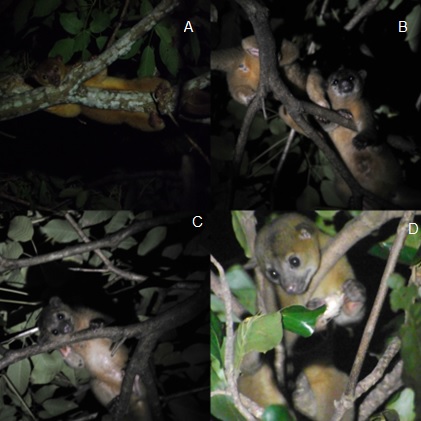
The kinkajou (Potos flavus) is a medium-sized, nocturnal, and arboreal mammal. It is distributed in the neotropical forests from western Mexico, Central and South America. Despite its wide distribution, this species is poorly studied. In this note we present the first record of P. flavus in the Playa La Marinera Reserve Zone, in Panama, expanding knowledge of its distribution in a region where no previous records of its presence existed. In addition, we document the consumption of tropical almond (Terminalia catappa) fruits, an introduced species in Panama. These records underscore the need for additional research on the biology, behavior, and threats of this species in the area.
References
Aguiar LM, Moro-Rios RF, Silvestre T, Silva-Pereira JE, Bilski DR, Passos FC, Sekiama ML, Rocha VJ. 2011. “Diet of Brown-Nosed Coatis and Crab-Eating Raccoons from a Mosaic Landscape with Exotic Plantations in Southern Brazil.” Studies on Neotropical Fauna and Environment 46(3):153–61. http://dx.doi.org/10.1080/01650521.2011.640567
Anand A, Divya N, Kotti P. 2015. An updated review of Terminalia catappa. Pharmacognosy reviews. 9(18): 93. https://doi.org/10.4103/0973-7847.162103
Arrázola-Paternina GS, Alvis-Bermúdez A, Herazo-Camacho IC. 2015. Aprovechamiento tecnológico del almendro de india (Terminalia catappa L) para la obtención de productos alimenticios. Revista Orinoquia. 19(1):27-34. https://doi.org/10.22579/20112629.312
Bisbal FJ. 1986. Food habits of some neotropical carnivores in Venezuela (Mammalia, Carnivora). Mammalia. 50(3):329-340. https://doi.org/10.1515/mamm.1986.50.3.329
Cuervo-Díaz A, Hernández-Camacho J, Cadena-G A. 1986. Lista actualizada de los mamíferos de Colombia anotaciones sobre su distribución. Caldasia. 15(71–75):471–501. https://revistas.unal.edu.co/index.php/cal/article/view/35095
Emmons L, Feer F. 1997. Neotropical rainforest mammals. Second edition. Chicago and London. The University of Chicago Press.
Ford LS, Hoffman RS. 1988. Potos flavus. Mammalian Species. 321:1-9. https://doi.org/10.2307/3504086
Figueroa F, Arita H. 2005. Martucha, mico de noche. In: Ceballos G, Oliva G, editors. Los mamíferos silvestres de México. México D.F. (MX): Comisión Nacional para el Conocimiento y Uso de la Biodiversidad. p. 405–408.
Galvis NF, Link A, Mosquera D, Vinueza-Hidalgo G, Carrillo L, Mopán-Chilito AM, Montilla O. 2024. Notes on the ecology, activity patterns and behavior of the kinkajou (Potos flavus). Mammalia. 88(9):292-298. https://doi.org/10.1515/mammalia-2023-0055
GBIF. 2024. GBIF Occurrence Download https://doi.org/10.15468/dl.hfk29u
González B, Brook F, Martin GM. 2022. Updated distribution and conservation perspectives of marmosine opossums from Colombia. Hystrix: The Italian Journal of Mammalogy, 33(1). http://dx.doi.org/10.4404/hystrix-00489-2021
Gregory T, Carrasco-Rueda F, Balbuena D, Kolowski J. 2022. Rush
hour: arboreal mammal activity patterns in natural canopy bridges in
the Peruvian Amazon. Folia Primatologica. 93:465–477. http://dx.doi.org/10.1163/14219980-20211209
Helgen K, Kays R, Schipper J. 2016. Potos flavus. The IUCN Red List of Threatened Species 2016: e.T41679A45215631. https://dx.doi.org/10.2305/IUCN.UK.2016-1.RLTS.T41679A45215631.en
Hernández-Camacho J. 1977. Notas para una monografía de Potos flavus (Mammalia: Carnivora) en Colombia. Caldasia. 11(55):147–181. https://revistas.unal.edu.co/index.php/cal/article/view/34361
Hernández-Guzmán J. 2020. Nuevos registros de la martucha Potos flavus (PROCYONIDAE) en las tierras bajas de Tabasco, México. Revista Mexicana de Mastozoología nueva época. 10(1):47-51. https://doi.org/10.22201/ie.20074484e.2020.10.1.292
iNaturalist contributors. 2025a. "Observaciones del género Citrullus en la región 7003, Panamá." iNaturalit. https://panama.inaturalist.org/observations?place_id=7003&subview=map&taxon_id=70055. Accedido el 5 de abril de 2025.
iNaturalist contributors. 2025b. "Observaciones del género Eriobotrya en la región 7003, Panamá." iNaturalist. https://panama.inaturalist.org/observations?place_id=7003&subview=map&taxon_id=72119. Accedido el 5 de abril de 2025.
iNaturalist contributors. 2025c. "Observaciones de Morus alba en la región 7003, Panamá." iNaturalist. https://panama.inaturalist.org/observations?place_id=7003&subview=map&taxon_id=56090. Accedido el 5 de abril de 2025.
Janzen DH. 1983. Costa Rica Natural History. The University of Chicago Press.
Jiménez J, Espino K. 2020. Guía de árboles y plantas arborescentes de la Universidad Tecnológica de Panamá, Extensión Tocumen. Inf. téc. Universidad Tecnológica de Panamá. https://ridda2.utp.ac.pa/handle/123456789/11456
Julien-Laferrière D. 1993. Radio-tracking observations on ranging and foraging patterns by kinkajous (Potos flavus) in French Guiana. Journal of Tropical Ecology. 9:19–32. https://doi.org/10.1017/S0266467400006908
Julien-Laferrière D. 1999. Foraging strategies and food partitioning in the
neotropical frugivorous mammals Caluromys philander and Potos
flavus. Journal of Zoology. 247:71–80. https://doi.org/10.1111/j.1469-7998.1999.tb00194.x
Julien-Laferrière D. 2001. Frugivory and seed dispersal by kinkajous. In: Bongers F, Charles-Dominique P, Forget PM, Théry M, editors. Nouragues: dynamics and plant-animal interactions in a neotropical rainforest. Dordrecht: Springer Netherlands. p. 217-226.
Kays RW. 1999. Food preferences of Kinkajous (Potos flavus): a frugivorous carnivore. Journal of Mammalogy. 80:589–599. https://doi.org/10.2307/1383303
Kays RW. 2000. The behavior and ecology of olingos (Bassaricyon gabbii)
and their competition with kinkajous (Potos flavus) in central Panama.
Mammalia. 64:1–10. https://doi.org/10.1515/mamm.2000.64.1.1
Kays RW. 2003. Social polyandry and promiscuous mating in a primate-
like carnivore: the kinkajou (Potos flavus). In: Reichard UH, Boesch C, editors. Monogamy: mating strategies and partnerships in
birds, humans and other mammals. Cambridge University Press,
Cambridge, UK. p. 125–137.
Kays RW, Gittleman JL. 1995. Home range size and social behavior of
kinkajous (Potos flavus) in the Republic of Panama. Biotropica. 27:530–534. https://doi.org/10.2307/2388969
Kays RW, Gittleman JL. 2001. The social organization of the kinkajou (Potos flavus) (Procyonidae). Journal of Zoology. 253:491–504. https://doi.org/10.1017/S0952836901000450
Koepfli KP, Gompper ME, Eizirik E, Ho CC, Linden L, Maldonado JE, Wayne RK. 2007. Phylogeny of the Procyonidae (Mammalia: Carnivora): molecules, morphology and the great American interchange. Molecular Phylogenetics and Evolution. 43: 1076–1095. https://doi.org/10.1016/j.ympev.2006.10.003
Lezcano JL, López OR. 2014. Historia natural de la vegetación costero-litoral del Istmo de Panamá. In: Rodríguez-Mejía FA, O’Dea A, editors. Toppan Leefung Printing Limited, Hong Kong. p. 83-102.
Marciniak B, Machado LP, de Campos LLF, Hirota M, Dechoum MS. 2022. Direct and indirect effects of an invasive non-native tree on coastal plant communities. Plant Ecology. 223(8):935-949. https://doi.org/10.1007/s11258-022-01246-5
McClearn D, Roman H, Horan S, Rose W. 1996. Canopy mammal trapping on Barro Colorado Island, Panama: a six month survey. Selbyana. 27-35. https://www.jstor.org/stable/41759921
Mensah JB, Forget PM, Guilbert E, Herrel A, Ofori BY, Naas AG. 2024. Night life: Positional behaviors and activity patterns of the Neotropical kinkajou, Potos flavus (Carnivora, Procyonidae). Journal of Zoology. 324(3):231-243. https://doi.org/10.1111/jzo.13211
Miranda JES, Melo FR, Fachi MB, Oliveira SR, Umetsu RK. 2018. New records of the Kinkajou, Potos flavus (Schreber, 1774) (Mammalia, Carnivora) in the Cerrado. Check List. 14(2):357-361. https://doi.org/10.15560/14.2.357
Monterrubio-Rico TC, Charre-Medellín JF, Villanueva-Hernández AI, León-Paniagua L. 2013. Nuevos registros de la martucha (Potos flavus) para Michoacán, México, que establecen su límite de distribución al norte por el Pacífico. Revista mexicana de biodiversidad. 84(3):1002-1006. https://doi.org/10.7550/rmb.34419
Osorio-Rodriguez AN, Juárez-Agis A, Vázquez-Arroyo E, Almazán-Catalán JA, Garzón-López LA, Radilla-Romero M. 2023. Registros Recientes De La Martucha (Potos Flavus, Carnivora: Procyonidae) En El Estado De Guerrero, México, Con Comentarios De Su Ocurrencia y Amenazas. Mammalogy Notes 9(2):293. https://doi.org/10.47603/mano.v9n2.293.
Polo EA, Moreno Y. 2022. Producción y calidad de biomasa de la morera (Morus alba) bajo tres distancias de siembra y frecuencias de poda. Revista Semilla del Este, 3(1), 66-75.
Reid F. A. 1997. A Field Guide to the Mammals of Central America and Southeast Mexico. Oxford University Press, New York, 334 pp. ISBN 0-19-506400-3.
Reid, F. A. 2009. A Field Guide to the Mammals of Central America & Southeast Mexico. 2nd ed. Oxford University Press, New York, 346 pp.
Sampaio R, Beisiegel B, Mendes AR. 2013. Avaliação do risco de extinção do jupará Potos flavus (Schreber, 1774) no Brasil. Biodiversidade Brasileira. 3(1):277-282. https://doi.org/10.37002/biodiversidadebrasileira.v3i1.397
Schipper J. 2007. Camera-trap avoidance by Kinkajous (Potos flavus):
rethinking the “non-invasive” paradigm. Small Carnivore Conservation. 36:38–41.
STRI Research Portal 2025. "Eriobotrya japonica (Thunb.) Lindl." Panama Biota. Accedido el 5 de abril de 2025. https://panamabiota.org/stri/taxa/index.php?taxon=64684&clid=71
Thomson LA, Evans B. 2006. Terminalia catappa (tropical almond). Species Profiles for Pacific Island Agroforestry. 2(2):1-20.
Udotong J.I., Bassey M.I. 2015. Evaluation of the chemical composition, nutritive value and antinutrients of Terminalia catappa L. fruit (Tropical Almond). International Journal of Engineering and Technical Research 3(9):96-99.
Vásquez OS, González FE. 2018. Evaluación de la densidad de nidos de tortuga lora (Lepidochelys olivacea), en la Playa La Marinera, Guánico Abajo de Tonosí, Provincia de Los Santos, año 2010. Revista Saberes Apudep. 1(1):130-151.
Walker PL, Cant J. 1977. A population survey of kinkajous (Potos flavus)
in a seasonally dry tropical forest. Journal of Mammalogy. 58:100–102. https://doi.org/10.2307/1379740
Wright SJ, Gompper ME, DeLeon B. 1994. Are Large Predators Keystone Species in Neotropical Forests? The Evidence from Barro Colorado Island. Oikos. 71(2):279–294. https://doi.org/10.2307/3546277
Zizka A, Silvestro D, Andermann T, Azevedo J, Ritter CD, Edler D, Farooq H, Herdean A, Ariza M, Scharn R, Svantesson S, Wengström N, Zizka V, Antonelli A, 2019. CoordinateCleaner: Standardized cleaning of occurrence records from biological collection databases. Methods Ecol. Evol. 10(5): 744–751. https://doi.org/10.1111/2041-210X.13152
Zwolak, R., Sih, A. (2020). Animal personalities and seed dispersal: a conceptual review. Functional Ecology, 34(7), 1294-1310. https://doi.org/10.1111/1365-2435.13583

This work is licensed under a Creative Commons Attribution 4.0 International License.