
Keywords
distribution
tropical dry forest
Magdalena Valley
Tolima
How to Cite
Accepted 2021-05-08
Published 2021-05-09




Abstract
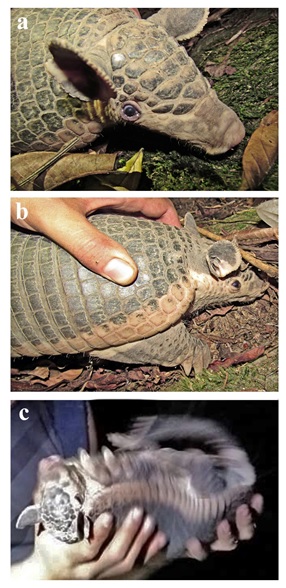
Colombia is a country with a great richness of armadillos, with six species belonging to three genera, covering most of the national territory. One of them, Cabassous centralis, is the only trans-andean species. An individual of Cabassous centralis was found and photographed during a snake-searching in January of 2019. The casual encounter occurs at the eastern Tolima department, in the slopes of Eastern Cordillera. This record, together with a specimen preserved in the mammal collection of the Alexander von Humboldt Biological Resources Research Institute, confirm the presence of the species in the department and are the southernmost records in its distribution within the Magdalena Valley.
References
Alberico M, Cadena A, Hernández-Camacho J, Muñoz-Saba Y. 2000. Mamíferos (Synapsida: Theria) de Colombia. Biota Colombiana. 1(1): 43-75.
Aya-Cuero C, Trujillo F, Mosquera-Guerra F, Chacón-Pacheco J, Caicedo D, Franco-León N, & Superina M. 2019. Distribution of armadillos in Colombia, with an analysis of ecoregions and protected areas inhabited. Mammal Research. 64: 569-580. https://doi.org/10.1007/s13364-019-00435-4
Chacón-Pacheco, J, Ballesteros-Correa J, Racero-Casarrubia J. 2019. Primer registro en cámaras trampas del armadillo coletrapo Cabassous centralis (Cingulata, Chlamyphoridae) en el departamento de Córdoba, Colombia. Oecología Australis. 23 (1): 150-155
Cruz-Rodríguez C, Larrotta L, González-Maya J, Zárrate-Charry D, Cepeda A, Balaguera-Reina S, Ange-Jaramillo C, Zamora A, Castaño-Uribe C. 2011. New records for the northern naked-tailed armadillo Cabassous centralis (Cingulata: Dasypodidae) in tropical dry forest of the department of Sucre, Colombian Caribbean. Revista Mexicana de Mastozoología. 15: 39-45.
García-Herrera L, Ramírez-Fráncel L, Reinoso-Flórez G. 2015. Mamíferos en relictos de seco tropical del Tolima, Colombia. Mastozoología Neotropical. 22 (1): 11-21
García-Herrera L, Ramírez-Fráncel L, Reinoso-Flórez G. 2019. Mamíferos del departamento del Tolima: distribución y estado de conservación. Revista U.D.C.A Actualidad & Divulgación Científica. 22. https://doi.org/10.31910/rudca.v22.n2.2019.1100
Gardner AL. (ed). 2008. Mammals of South America. Volumen 1: Marsupials, xenarthrans, shrews and bats. The University of Chicago Press, 669 pp.
Hayseen V, Ortega J, Morales-Leyva A, Martínez-Mendez N. 2013. Cabassous centralis (Cingulata: Dasypodidae). Mammalian Species. 45: 12-17. https://doi.org/10.1644/898.1
Hernández-Camacho J, Hurtado AG, Rosario Ortiz Q, Walschburger T. 1992. Unidades biogeográficas de Colombia. Pp. 105-151. En: Halffter IG, (ed). La Diversidad Biológica de Iberoamérica. Acta Zoológica Mexicana, Instituto de Ecología, A.C., México, México.
IDEAM. Promedios climatológicos (1971-2000 y 1981-2010). Colombia. 2017. Disponible en: http://www.ideam.gov.co/web/tiempo-y-clima/clima Acceso el 18 Marzo 2021.
Ramírez-Chaves HE, Suárez-Castro AF, González-Maya JF. 2016. Cambios recientes a la lista de los mamíferos de Colombia. Mammalogy Notes. 3 (1-2): 1-9. https://doi.org/10.47603/manovol3n1.1-9
Rodríguez-Mahecha JV, Alberico M, Trujillo F, Jorgenson J. (eds.). 2006. Libro Rojo de los Mamíferos de Colombia. Serie Libros Rojos de Especies Amenazadas de Colombia. Conservación Internacional Colombia, Ministerio de Ambiente, Vivienda y desarrollo Territorial. Bogotá, Colombia. 429 pp
Sánchez-Brenes R, Monge J. 2019. El armadillo, Cabassous centralis (Cingulata: Chalyphoridae) en agroecosistemas con café de Costa Rica. UNED Research Journal, 11 (3), 436-443. https://doi.org/10.22458/urj.v11i3.2724
Sánchez-Soto S, Ramírez-Arenas C, Esteban-Guzmán N, Sánchez-Gómez W.S. 2020. Registro notable de armadillo de cola desnuda, Cabassous centralis (Cingulata: Chlamyphoridae), en el estado de Chiapas, México. Mammaloy Notes, 6 (2): 165 https://doi.org/10.47603/mano.v6n2.165
Santos PM, Bocchiglieri A, Chiarello AG, Paglia AP, Moreira A, De Souza AC, Abba AM, Paviolo A, Gatica A, Medeiro AZ, et al. 2019. NEOTROPICAL XENARTHRANS: a data set of occurrences of xenarthran species in the Neotropics. Ecology. 100(7): e02663. https://doi.org/10.1002/ecy.2663
Solari S, Muñoz-Saba Y, Rodríguez-Mahecha JV, Defler TR, Ramírez-Chaves HE, Trujillo F. 2013. Riqueza, endemismo y conservación de los mamíferos de Colombia. Mastozoología Neotropical. 20: 301-365.
Soriero VR, Wooldridge RL, Harmsen BJ, Charette M, Kilburn V, Foster RJ. 2018. Range extension of Northern Naked-tailed Armadillo, Cabassous centralis Miller, 1899 (Mammalia, Cingulata, Chlamyphoridae), in Belize. Check List. 14 (5): 839-843. https://doi.org/10.15560/14.5.839
Tirira DG, Díaz-N J, Superina M, Abba AM. 2014. Cabassous centralis. The IUCN Red List of Threatened Species. e.T3412A47437304. https://dx.doi.org/10.2305/IUCN.UK.2014-1.RLTS.T3412A47437304 Acceso 15 Abril 2021.

This work is licensed under a Creative Commons Attribution 4.0 International License.