
Supplementary Files
Keywords
cordillera Central
Magdalena
How to Cite
Accepted 2020-05-04
Published 2020-06-18




Abstract
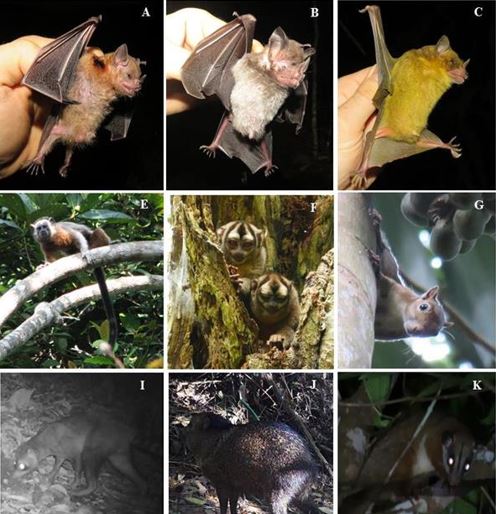
The Andean region in Colombia is home to at least 192 species of wild mammals. However, it is a highly transformed region, so the establishment and monitoring of reserves is essential for the maintenance of biodiversity. We made the inventory of the wild mammals of the Hacienda San Pedro Natural Reserve, Maceo, Antioquia. 40 species belonging to eight orders and 17 families are registered. Endangered and endemic species such as Saguinus leucopus, Aotus griseimembra, Notosciurus pucheranii and Proechimys crysaeolus were found. The site assembly presented frequent species from the Magdalena Medio region, as well as from the Central Andes. We hope that this work is a contribution to the academic practices carried out in the reserve and that it highlights its contribution to the conservation of wild mammals at the regional level.
References
Baldwin R, Fouch N. 2018. Understanding the Biodiversity Contributions of Small Protected Areas Presents Many Challenges. Land 7, 123. https://doi.org/10.3390/land7040123
Bingham H, Fitzsimons JA, Redford K, Mitchell BA, Bezaury-Creel J, Cumming TL. 2017. Privately protected areas: advances and challenges in guidance, policy and documentation. PARKS 23, 13–28. https://doi.org/10.2305/IUCN.CH.2017.PARKS-23-1HB.en
Corporación Autónoma Regional del Centro de Antioquia, 2009. Formulación del Plan Integral de Manejo del Distrito de Manejo Integrado de los Recursos Naturales del Cañón del Río Alicante.
Cuartas-Calle CA, Marín Cardona D. 2014. Guía ilustrada, mamíferos: Cañón del río Porce, Antioquia. EPM E.S.P. Universidad de Antioquia, Herbario Universidad de Antioquia, Medellín, Colombia.
Díaz MM, Solari S, Aguirre LF, Aguiar L, Barquez RM. 2016. Clave de identificación de los murciélagos de Sudamérica, 2nd ed. Yer ba Buena, Tucumán, Argentina.
Emmons LH, Feer F. 1999. Mamíferos de los bosques húmedos de América tropical: una guía de campo, 1st ed. Editorial F.A.N, Santa Cruz de la Sierra, Bolivia.
Gardner AL. 2007. Mammals of South America, Volume 1: Marsupials, Xenarthrans, Shrews, and Bats. University of Chicago Press, Chicago.
Groves C. 2003. Drafting a conservation blueprint: a practitioner’s guide to planning for biodiversity. Island Press, Washington.
Holdridge LR. 1967. Life Zone Ecology. Tropical Science Center, San Jose, Costa Rica.
IUCN. 2020. The IUCN Red List of Threatened Species. https://www.iucnredlist.org. Downloaded on 19 March 2020.
Morales-Jiménez AL, Link A. 2008. Aotus griseimembra: The IUCN Red List of Threatened Species 2008: e.T1807A7650460. https://doi.org/10.2305/IUCN.UK.2008.RLTS.T1807A7650460.en
Morales-Jiménez AL, Link A, Stevenson P. 2008 Saguinus leucopus: The IUCN Red List of Threatened Species 2008: e.T19819A9019454. https://doi.org/10.2305/IUCN.UK.2008.RLTS.T19819A9019454.en
Kattán G, Naranjo LG. 2008. Regiones biodiversas: herramientas para la planificación de sistemas regionales de áreas protegidas. WCS Colombia: Fundación EcoAndina : WWF Colombia, Santiago de Cali, Colombia.
Lovejoy TE, 2006. Protected areas: a prism for a changing world. Trends in Ecology & Evolution 21, 329–333. https://doi.org/10.1016/j.tree.2006.04.005
Matallana CL, Lasso CA, Baptiste MP. 2012. Carne de monte y consumo de fauna silvestre en la Orinoquia y Amazonia (Colombia y Venezuela), 1st ed. Instituto de Investigación de Recursos Biológicos Alexander von Humboldt, Bogota D.C., Colombia.
Mayorquín A, Valenzuela S, Rangel-CH JO. 2010. Evaluación de la efectividad de manejo en reservas naturales de la sociedad civil: una propuesta metodológica. Caldasia 32, 381–397.
Patton JL, Pardiñas UFJ, D’Elía G. 2015. Mammals of South America, Volume 2: Rodents. University of Chicago Press. https://doi.org/10.7208/chicago/9780226169606.001.0001
Quintero-Vallejo E, Benavides AM, Moreno N, Gonzales-Caro S. 2018. Bosques Andinos, estado actual y retos para su conservación en Antioquia, 1st ed. Fundación Jardín Botánico de Medellín Joaquín Antonio Uribe - Programa Bosques Andinos (COSUDE), Medellín, Colombia.
Ramírez-Chaves HE, Suárez-Castro AF, Sociedad Colombiana de Mastozoología. 2019. Mamíferos de Colombia. https://doi.org/10.15472/kl1whs
Ramírez-Chaves HE, Suárez-Castro AF, González-Maya JF. 2016. Cambios recientes a la lista de los mamíferos de Colombia. MaNo 3, 21.
Rodríguez-Mahecha JV, Landazábal Mendoza C, Nash SD. 2006. Libro rojo de los mamíferos de Colombia, Serie Libros rojos de especies amenazadas de Colombia. Conservación Internacional Colombia: Ministerio de Ambiente, Vivienda y Desarrollo Territorial, República de Colombia, Bogotá.
Sánchez-Londoño JD, Tuberquia DJ, Parra JL. 2019. Estudios en biodiversidad del Alto de San Miguel, 1st ed. Editorial CES, Medellín: Universidad CES.
Solari S, Muñoz-Saba Y, Rodríguez-Macheda J, Defler T, Ramírez-Chaves H, Trujillo F. 2013. Riqueza, endemismo y conservación de los mamíferos de Colombia. Mastozool Neotropica. Mastozool Neotropical 20, 301–365.
Wildlife Conservation Society. 2015. Diversidad biológica en un fragmento de bosque del orobioma bajo de los Andes, Reserva Natural Hacienda San Pedro, municipio de Maceo, Antioquia.

This work is licensed under a Creative Commons Attribution-ShareAlike 4.0 International License.