Keywords
How to Cite
Published 2017-01-15




Abstract
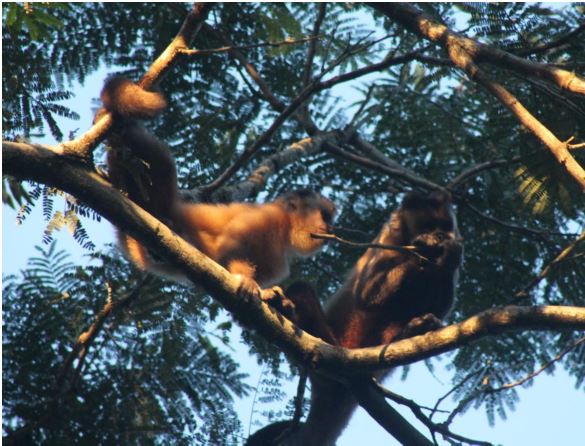
The majority of reports of self-medication in capuchins focus on fur-rubbing behaviours (Fragaszy et al., 2004; Paukner & Suomi, 2012; Meuner et al., 2008). Here, we report on observations of Hooded Capuchins in Rancho Laguna Blanca (RLB), feeding on the bark of the tree Albizia niopoides (Mimosaceae), a possible case of self-medication.
References
ABDALLA, M.A & H LAATSCH 2012. Flavonoids from Sudanese Albizia zygia (Legminosae, subfamily Mimosoideae), A Plant with Antimalarial Potency. African Journal of Traditional Complementary and Alternative Medicines 9: 56-58.
ALTMANN, J 1974. Observational Study of Behavior: Sampling Methods. Behaviour 49: 227-267.
ARCE, M.L.R 1992. Notes on Albizia niopoides (Spruce ex Benth.) Burkart (Leguminosae: Mimosoideae). Kew Bulletin 47: 699-702.
CLAYTON, D.H & N.D WOLFE 1993. The Adaptive Significance of Self-Medication. TREE 8: 60–63.
FRAGASZY, D.M et al 2004. The Complete Capuchin: The Biology of the Genus Cebus. Cambridge University Press, Cambridge, UK. p 102-104.
HUFFMAN, M.A 1997. Current Evidence for Self-Medication in Primates: A Multidisciplinary Perspective. Yearbook of Physical Anthropology 40:171-200.
HUFFMAN, M.A 2003. Animal Self-Medication and Ethno-Medicine: Exploration and Exploitation of the Medicinal Properties of Plants. Proceedings of the Nutrition Society 62: 371-381.
HUFFMAN, M.A et al 1996. Leaf-Swallowing by Chimpanzees: A Behavioral Adapatation for the Control of Strongyle Nematode Infections. International Journal of Primatology 72: 475-503.
HUFFMAN, M.A & J.M CATON 2001. Self-Induced Increase of Gut Motility and the Control of Parasitic Infections in Wild Chimpanzees. International Journal of Primatology 22: 329-346.
JAIN, C.P et al 2008 Animal Self-Medication through Natural Sources. Natural Product Radiance 7: 49-53.
JANGWAN, J.S 2010. New Cytotoxic Saponin of Albizia lebbeck. Indian J Chemists 49:123-126.
JEFFERSON, J.P 2014. Owl Monkeys (Aotus spp.) Perform Self- and Social Anointing in Captivity. Folia Primatologia 85: 119-134.
KOKILA, K et al 2013. Phytopharmacological Properties of Albizia Species: A Review. International Journal Pharmacy and Pharmaceutical Science 5: 70-73.
LAU, C.S et al 2007. Identification and Quantification of Glycoside Flavonoids in the Energy Crop Albizia Julibrissin. Bioresour Technol 98: 429-435.
LASKA, M et al 2007. Self-Anointing Behaviour in Free-Ranging Spider Monkeys (Ateles geoffroyi) in Mexico. Primates 48: 160-163.
LECA, J.B et al 2007. Social Aspects of Fur-Rubbing in Cebus capucinus and C. apella. International Journal of Primatology 28: 801-817.
LINK, A et al 2011. Patterns of Mineral Lick Visitation by Spider Monkeys and Howler Monkeys in Amazonia: Are Licks Perceived as Risky Areas? American Journal of Primatology 73: 386-396.
LYNCH ALFARO, J.W et al 2011. Anointing Variation Across Wild Capuchin Populations: A Review of Material Preferences, Bout Frequency and Anointing Sociality in Cebus and Sapajus. American Journal of Primatology 7: 1-16.
OVENDEN, S.P 2002. Spermine Alkaloids from Albizia adinocephala with Activity Against Plasmodium falciparum Plasmepsin II. Phytochem. 60: 175-177.
MASI, S et al 2012. Unusual Feeding Behavior in Wild Great Apes, a Window to Understand Origins of Self-Medication in Humans: Role of Sociality and Physiology on Learning Process. Physiology & Behavior 105: 337-349.
MEUNER, H 2008. Social Facilitation of Fur Rubbing in White-Faced Capuchins. American Journal of Primatology 70: 161-168.
PARR N.A, L.M FEDIGAN, S.J KUTZ 2013. A Coprological Survey of Parasites in White-Faced Capuchins (Cebus capucinus) from Sector Santa Rosa, ACG, Costa Rica. Folia Primatologia 84:102–114
PAUKNER, A & S.J SUOMI, 2012. Social After-Effects of Fur Rubbing in Tufted Capuchin Monkeys (Cebus apella): Increased Antagonism and Reduced Affiliation. Primates 53: 297-301.
PERRY, S & J.H MANSON 2008. Manipulative Monkeys. Harvard University Press, Cambridge, Massachusetts, USA. p 60.
SMITH, R.L & E BRIGGS 2015. Using Camera Traps to Determine Group Demographics in a Paraguayan Population of Sapajus Cay. Neotropical Primates 22: 81-88.
WELDON, P.J et al 2003. Benzoquinones from Millipedes Deter Mosquitoes and Elicit Self-Anointing in Capuchin Monkeys (Cebus spp.). Naturwissenschaften 90: 301-304.
YADAVA, R.N & P TRIPATHI 2000. Chemical Examination and Anti-Inflammatory Action of the Extract from the Stem of Albizia procera. Research Journal of Chemistry and the Environment 4: 57-60.
ZHANG, H 2011 Cytotoxic Oleanane-Type Saponins from Albizia inundata. Journal of Natural Products 74: 477-482.

This work is licensed under a Creative Commons Attribution-ShareAlike 4.0 International License.