
Keywords
xenarthrans
wildlife telemetry
road ecology
One Health
conservation
How to Cite
Published 2026-06-10




Abstract
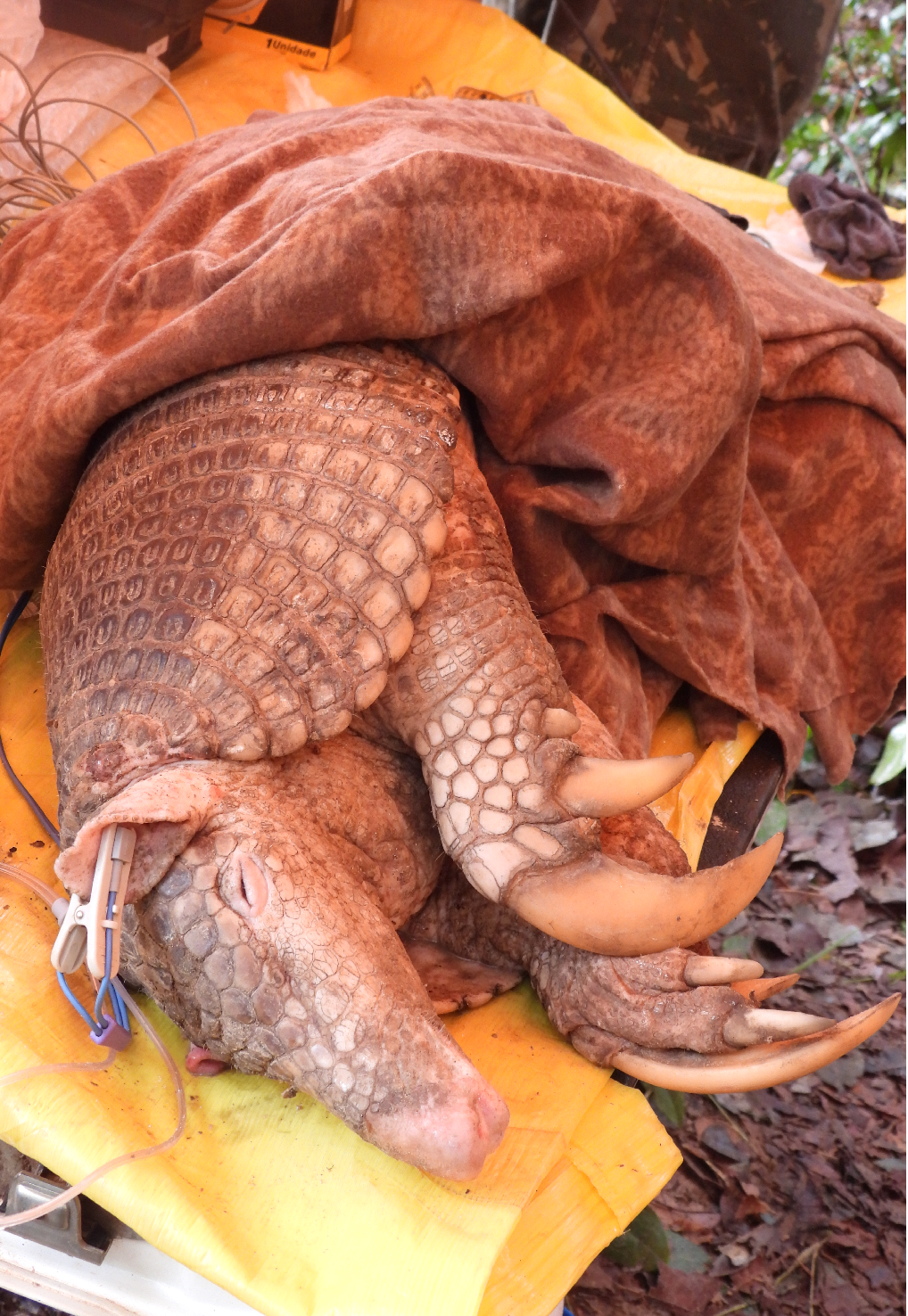
Xenarthrans are a priority group for conservation in South America because of their unique evolutionary history and the increasing threats associated with landscape transformation. Despite their importance, major knowledge gaps remain regarding the ecology and conservation of several species, particularly in Colombia. In this editorial, we highlight how scientific cooperation between Colombia and Brazil, through the partnership between the Colombian Mammalogical Society (ScMas) and the Instituto de Conservação de Animais Silvestres (ICAS), has strengthened the exchange of methodologies for the study and conservation of the giant anteater (Myrmecophaga tridactyla) and the giant armadillo (Priodontes maximus). The training experience in Brazil provided practical knowledge on wildlife telemetry, genetic monitoring, road ecology, and One Health approaches, offering valuable tools that can be adapted to strengthen xenarthran research and conservation in Colombia. Beyond technical training, this experience illustrates the importance of regional scientific collaboration for advancing conservation.
References
Desbiez, A. L., & Attias, N. (2021). The Imperiled Giant Armadillo: ecology and conservation. Reference Module in Earth Systems and Environmental Sciences. Elsevier B. https://doi.org/10.1016/B978-0-12-821139-7.00216-6
Fontes, B. L., Desbiez, A. L. J., Massocato, G. F., Srbek-Araujo, A. C., Sanaiotti, T. M., Bergallo, H. G., Ferreguetti, A.C., Ribeiro, C.H., Roberto, V., Valls, R., Oliveira, D., Gatti, A., Sá, E., Banhos, A. (2020). The local extinction of one of the greatest terrestrial ecosystem engineers, the giant armadillo (Priodontes maximus), in one of its last refuges in the Atlantic Forest, will be felt by a large vertebrate community. Global Ecology and Conservation, 24, e01357. https://doi.org/10.1016/j.gecco.2020.e01357
Marvin, D. C., Koh, L. P., Lynam, A. J., Wich, S., Davies, A. B., Krishnamurthy, R., & Asner, G. P. (2016). Integrating technologies for scalable ecology and conservation. Global Ecology and Conservation, 7, 262-275. https://doi.org/10.1016/j.gecco.2016.07.002
Miranda, F., Bertassoni, A., y Abba, A. M. (2014). Myrmecophaga tridactyla (Giant Anteater). April. http://maps.iucnredlist.org/map.html?id=14224
Nigro, N. A., Gasparri, B., & Pepe Steger, E. (2021). Xenartros argentinos: guía para su identificación. Ciudad Autónoma de Buenos Aires, Fundación de Historia Natural Félix de Azara; Universidad Maimónides.
Pérez Gómez, K., Fernández Rodriguez R.B., Moreno Niño, N. (2025). Guía Ilustrada de los Mamíferos de Colombia. Ensifera Editores.
Pinto, F. A., Bager, A., Clevenger, A. P., & Grilo, C. (2018). Giant anteater (Myrmecophaga tridactyla) conservation in Brazil: Analysing the relative effects of fragmentation and mortality due to roads. Biological Conservation, 228, 148-157. https://doi.org/10.1016/j.biocon.2018.10.023
Schwartz, M. K., Luikart, G., & Waples, R. S. (2007). Genetic monitoring as a promising tool for conservation and management. Trends in Ecology & Evolution, 22(1), 25–33. https://doi.org/10.1016/j.tree.2006.08.009
Superina, M., Desbiez, A., Di Blanco, Y., Smith, P., De Thoisy, B. & Earl, E. (2025). Priodontes maximus. The IUCN Red List of Threatened Species 2025: e.T18144A244101181. https://dx.doi.org/10.2305/IUCN.UK.2025-1.RLTS.T18144A244101181.en. Consultado el 21 de enero de 2026.

This work is licensed under a Creative Commons Attribution 4.0 International License.