
Keywords
Behavior
Howler monkey
Matrix
Savanna
How to Cite
Accepted 2021-04-09
Published 2021-04-22




Abstract
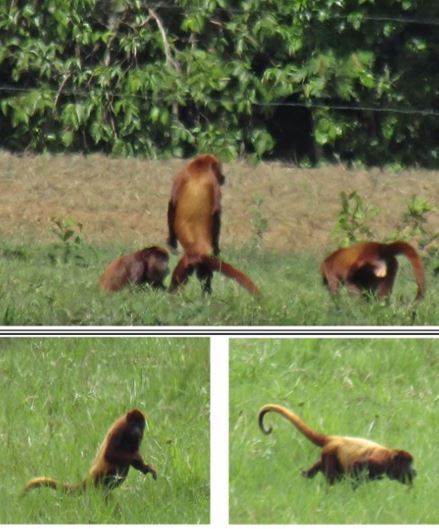
The landscape matrix has been considered to act as a barrier that influences the dispersal, diversity, and persistence of some species of fauna, but its importance has not been evaluated in detail for arboreal primates. Research on the genus Alouatta has reported terrestrial movements between forest patches suggesting certain behavioral plasticity that helps the efficient use of resources in reduced fragments. In addition to the use of the matrix for travel, it has been estimated, for Alouatta pigra, a high percentage of time spent on rest in this type of coverage. Here we report two occasional records of the use of savannas for resting and foraging by individuals of Alouatta seniculus, in a transition zone between the humid forest of the foothills and the drained savannas of the altillanura in the department of Meta, Colombia.
References
Anderson J, Rowcliffe JM, Cowlishaw G. 2007. Does the matrix matter? A forest primate in a complex agricultural landscape. Biological Conservation 135:212-222. https://doi.org/10.1016/j.biocon.2006.10.022
Aponte-Gutiérrez AF, Niño-Cárdenas IL, Arias-Escobar A, Lynch JD. 2019. Diversidad de anfibios y Reptiles en la región de la Serranía de Manacías, Municipio de San Martin, Meta, Orinoqía Colombia. In: Rangel-Ch OJ, Andrade-C MG, Jarro-F C, Santos-C G (Eds) Colombia diversidad biótica XVII: La región de la Serranía de Manacacías (Meta), Orinoquía colombiana. Bogotá DC, Colombia: Universidad Nacional de Colombia 431–448.
Arroyo-Rodríguez V, Mandujano S. 2009. Conceptualization and measurement of habitat fragmentation from the primates’ perspective. International Journal of Primatology 30:497-514. https://doi.org/10.1007/s10764-009-9355-0
Arroyo-Rodríguez V, Cuesta-del Moral E, Mandujano S, Chapman CA., Reyna-Hurtado R, Fahrig L. 2013. Assessing habitat fragmentation effects on primates: the importance of evaluating questions at the correct scale. En: Marsh L, Chapman CA, editors. Primates in Fragments. New York, USA: Springer. p. 13-28. https://doi.org/10.1007/978-1-4614-8839-2_2
Asensio N, Arroyo-Rodríguez V, Dunn JC, Cristóbal-Azkarate J. 2009. Conservation Value of Landscape Supplementation for Howler Monkeys Living in Forest Patches. Biotropica 41(6):768–773. https://doi.org/10.1111/j.1744-7429.2009.00533.x
Beltrán Vergara ML. 2005. Estrategias ecológicas e influencia de la dominancia social en la adquisición de alimento en monos aulladores (Alouatta seniculus) en Meta, Colombia. Tesis de pregrado. Universidad de los Andes.
Bicca-Marques JC. 2003. How do Howler Monkeys Cope with Habitat Fragmentation? En: Marsh LK, editora. Primates in Fragments. Boston, MA: Springer. https://doi.org/10.1007/978-1-4757-3770-7_18
Boyle SA, Lenz BB, Gilbert KA, Sprionello WR, Santamaría Gómez M, Setz, EZF, Marajó dos Reis A, Ferreira da Silva O, Keuroghlian A, Pinto, F. 2013. Primates of the biological dynamics of forest fragments project: A history. En: Marsh L, Chapman CA, editors. Primates in Fragments. New York, USA: Springer. p. 57-74. https://doi.org/10.1007/978-1-4614-8839-2_5
Carretero-Pinzón X. 2013. An eight-year life history of a primate community in the Colombian llanos. En: Marsh L, Chapman CA, editors. Primates in Fragments. New York, USA: Springer. p. 159-182). https://doi.org/10.1007/978-1-4614-8839-2_12
Casallas-Pabón D, Calvo-Roa N, Rojas-Robles R. 2017. Murciélagos dispersores de semillas en gradientes sucesionales de la Orinoquia (San martín, Meta, Colombia). Acta Biológica Colombiana. 22 (3): 348-358. DOI: http://dx.doi.org/10.15446/abc.v22n3.63561
Chapman CA, Peres CA. 2001. Primate conservation in the new millennium: the role of scientists. Evolutionary Anthropology 10:16–33. https://doi.org/10.1002/1520-6505(2001)10:1<16::AID-EVAN1010>3.0.CO;2-O
Clarke MR, Collins DA, Zucker EL. 2002. Responses to deforestation in a group of mantled howlers (Alouatta palliata) in Costa Rica. International Journal of Primatology 23(2):365-381. https://doi.org/10.1023/A:1013839713223
Crockett CM. 1996 The relation between red howler monkey (Alouatta seniculus) troop size and population growth in two habitats. En: Norconk MA, Rosenberger AL, Garber PA, editors. Adaptive radiation of neotropical primate. New York, USA: Plenum Press. P. 489–510
Cristóbal-Azkarate J, Dunn JC. 2013. Lessons from Los Tuxtlas: 30 years of research into primates in fragments. En: Marsh L, Chapman CA, editors. Primates in Fragments. New York, USA: Springer. p. 75-88. https://doi.org/10.1007/978-1-4614-8839-2_6
Cuervo A., Barbosa C, De la Ossa J. 1986. Aspectos ecológicos y etológicos de primates con énfasis en Alouatta seniculus (Cebidae) de la región de Coloso, Serranía de San Jacinto (Sucre), costa norte de Colombia. Caldasia 14(5): 709-714.
Defler TR. 1981 The density of Alouatta seniculus in the Llanos Orientales of Colombia. Primates 22: 564–569
Defler TR. 2003. Primates de Colombia. Conservación Internacional Colombia.
Gascon C, Lovejoy TE, Bierregaard RO, Malcolm JR, Stouffer PC, Vasconcelos HL, Laurance WF, Zimmerman B, Tocher M, Borges S. 1999. Matrix habitat and species richness in tropical forest remnants. Biological Conservation 91:223–229. https://doi.org/10.1016/S0006-3207(99)00080-4
Glander KF. 1975. Habitat description and resource utilization: A preliminary report on mantled howling monkey ecology. In: Tuttle R, editors. Socioecology and psychology of primates. The hague: Mouton. p. 37-57.
Glander KE. 1992. Dispersal patterns in Costa Rica mantled howling monkeys. International Journal of Primatology 13:415–436. https://doi.org/10.1007/BF02547826
Gómez-Posada C, Martínez J, Giraldo P, Kattan G. 2007 Density, habitat use and ranging patterns of red howler monkey in Andean forest. Neotropical Primates 14:2–10.
Henao-Díaz F. et al. 2020. Atlas de la biodiversidad de Colombia. Primates. Instituto de Investigación de Recursos Biológicos Alexander von Humboldt. Bogotá D. C., Colombia. 51 pp.
Horwich RH, Lyon J. 1993. A Belizean rain forest the community Baboon Sanctuary, 3rd ed. Orangutan, Gays Mills.
IDEAM. Promedios climatológicos (1971-2000 y 1981-2010). Colombia. 2017. Disponible en: http://www.ideam.gov.co/web/tiempo-y-clima/clima Acceso el 18 marzo 2021.
Izawa K, Lozano H. 1989. Social changes within a Group and Reproduction of Wild Howler Monkeys (Alouatta seniculus) in Colombia. Field Studies of New World Monkeys 2:1-6.
Laurance SG, Laurance WF. 1999. Tropical wildlife corridors: use of linear rainforest remnants by arboreal mammals. Biological Conservation 91:231–239. https://doi.org/10.1016/S0006-3207(99)00077-4
Lasso CA, Usma JS, Trujillo F, Rial A. 2010. Biodiversidad de la cuenca del Orinoco: bases científicas para la identificación de áreas prioritarias para la conservación y uso sostenible de la biodiversidad. Instituto de Investigación de Recursos Biológicos Alexander von Humboldt, WWF Colombia, Fundación Omacha, Fundación La Salle e Instituto de Estudios de la Orinoquia (Universidad Nacional de Colombia). Bogotá, D. C., Colombia. 609 pp.
Mandujano S, Escobedo-Morales LA, Palacios-Silva R. 2004. Movements of Alouatta palliata among forest fragments in Los Tuxtlas, Mexico. Neotropical Primates 12(3):126-131.
Milton K, Casey T, Casey K. 1979. The basal metabolism of mantled howler monkeys (Alouatta palliata). Journal of mammalogy 2:373–376. https://doi.org/10.2307/1379809
Nagy KA, Milton K. 1979. Aspects of dietary quality, nutrient assimilation and water balance in wild howler monkeys (Alouatta palliata). Oecologia 39:249–258. https://doi.org/10.1007/BF00345437
Palacios E, Rodríguez A. 2001. Ranging pattern and use of space in a group of Red Howler Monkeys (Alouatta seniculus) in southeastern Colombian Rainforest. American Journal of Primatology 55: 223-251. https://doi.org/10.1002/ajp.1057
Pardini R. 2004. Effects of forest fragmentation on small mammals in an Atlantic Forest landscape. Biodiversity and Conservation 13:2567–2586. https://doi.org/10.1023/B:BIOC.0000048452.18878.2d
Pozo-Montuy G, Serio-Silva JC. 2007. Movement and resource use by a group of Alouatta pigra in a forest fragment in Balancán, México. Primates 48:102-107. https://doi.org/10.1007/s10329-006-0026-x
Pozo-Montuy G, Serio-Silva JC, Bonilla-Sánchez YM. 2011. Influence of the landscape matrix on the abundance of arboreal primates in fragmented landscapes. Primates 52(2):139-147. https://doi.org/10.1007/s10329-010-0231-5
Pozo-Montuy G, Serio-Silva JC, Chapman CA, Bonilla-Sánchez YM. 2013. Resource use in a landscape matrix by an arboreal primate: evidence of supplementation in black howlers (Alouatta pigra). International Journal of Primatology 34:714-731. https://doi.org/10.1007/s10764-013-9691-y
Ramírez-Orjuela C. 2018. Influencia de la disponibilidad de alimento sobre el patrón de interacciones sociales del mono aullador negro y dorado (Alouatta caraya) en un bosque fragmentado del noreste argentino. Tesis para optar al título de Doctora en Biología. Facultad de Ciencias Exactas y Naturales y Agrimensura, Universidad Nacional del Nordeste. Argentina. 152p.
Rodríguez-Luna E, Shedden A, Solórzano-García B. 2013. A region-wide review of Mesoamerican primates: prioritizing for conservation. En: Marsh L, Chapman CA, editors. Primates in Fragments. New York, USA: Springer. p. 47-55. https://doi.org/10.1007/978-1-4614-8839-2_4
Silva FE, Bicca-Marques JC. 2013. Do patch size and interpatch distance influence the distribution of brown howler monkeys (Alouatta guariba clamitans) in a fragmented landscape in south Brazil? En: Marsh L, Chapman CA, editors. Primates in Fragments. New York, USA: Springer. p. 137-145. https://doi.org/10.1007/978-1-4614-8839-2_10
Solari S, Muñoz-Saba Y, Rodríguez-Mahecha JV, Defler TR, Ramírez-Chaves HE, Trujillo F. 2013. Riqueza, endemismo y conservación de los mamíferos de Colombia. Mastozoología Neotropical 20:301-365.

This work is licensed under a Creative Commons Attribution 4.0 International License.