
Keywords
geo
geophagy
herbivores
How to Cite
Accepted 2020-04-27
Published 2020-05-09




Abstract
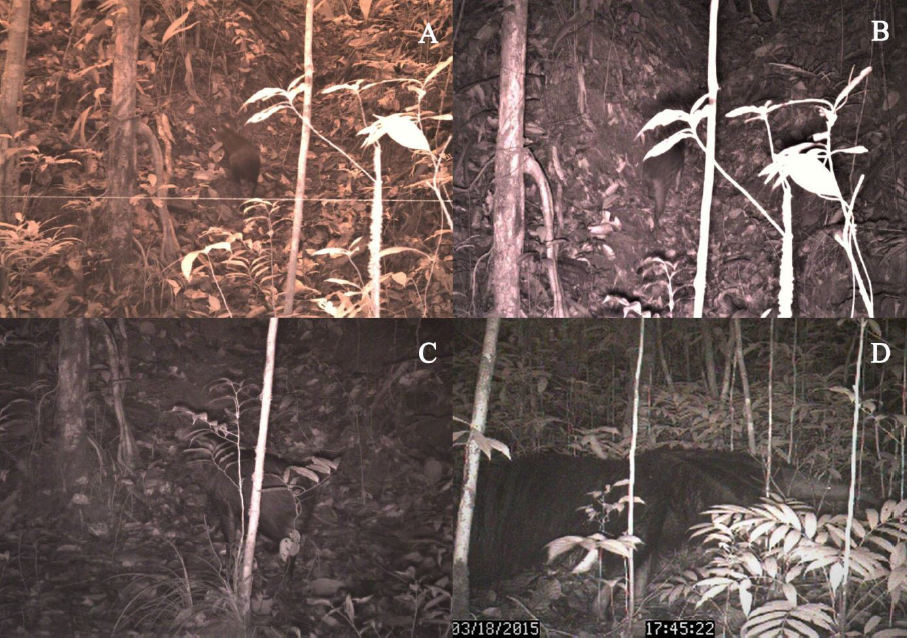
Natural salt licks are places with high concentrations of minerals and clays, where various species perform geophagy. In this note, we present records of land mammals in a salt flat located in the middle basin of the Caquetá River, within the Nonuya Villazul indigenous reservation. Four trap chambers were used and a total of four mammal species were registered, of which the most frequent was Cuniculus paca. Three of the registered species have a mostly frugivorous diet and are commonly registered in Amazonian salts. Myrmecophaga tridactyla is the only registered mammal that does not perform geophagy. Natural salts are places of ecological and conservation importance, since in them diversity of mammals converge mainly herbivores, however, to understand the characteristics that influence the presence or abundance of these species in salty, a greater effort of sampling is necessary in these and other ecosystems with the presence of salty.
References
Ayotte, J.B., Parker, K.L., Arocena, J.M., Gillingham, M.P., 2006. Chemical Composition of Lick Soils: Functions of Soil Ingestion by Four Ungulate Species. J Mammal 87, 878–888. https://doi.org/10.1644/06-MAMM-A-055R1.1
Blake, J.G., Mosquera, D., Guerra, J., Loiselle, B.A., Romo, D., Swing, K., 2011. Mineral Licks as Diversity Hotspots in Lowland Forest of Eastern Ecuador. Diversity 3, 217–234. https://doi.org/10.3390/d3020217
Blake, J.G., Mosquera, D., Salvador, J., 2013. Use of mineral licks by mammals and birds in hunted and non-hunted areas of Yasuní National Park, Ecuador: Hunting and mineral lick use in lowland Ecuador. Anim. Conservation 16, 430–437. https://doi.org/10.1111/acv.12012
Bravo, A., Harms, K.E., Emmons, L.H., 2012. Keystone resource (Ficus) chemistry explains lick visitation by frugivorous bats. J Mammal 93, 1099–1109. https://doi.org/10.1644/11-MAMM-A-333.1
Cabrera, J.A., 2015. Una historia de dos ciudades: cacería y conservación por fuera de áreas protegidas. El caso de la danta (Tapirus terrestris) en el Parque Nacional Natural Amacayacu, Colombia, in: Payán, E., Lasso, C.A.,
Castaño-Uribe, C. (Eds.), Conservación de Grandes Vertebrados En Áreas No Protegidas de Colombia, Venezuela y Brasil, Serie Editorial Fauna Silvestre Neotropical. Instituto de Investigación de Recursos Biológicos Alexander von Humboldt (IAvH), Bogotá D.C., Colombia, pp. 99–114.
Cabrera, J.A., 2012. Natural licks and people: Towards an understanding of the ecological and social dimensions of licks in the Colombian Amazon (Tesis doctoral). University of Kent, Reino Unido.
Dubost, G., Henry, O., 2006. Comparison of diets of the acouchy, agouti and paca, the three largest terrestrial rodents of French Guianan forests. J Trop Ecol 22, 641–651. https://doi.org/10.1017/S0266467406003440
Duivenvoorden, J.F., Lips, J.M., 1993. Ecología del paisaje del medio Caquetá: memoria explicativa de los mapas. Tropenbos, Bogotá D.C., Colombia.
Gilardi, J.D., Duffey, S.S., Munn, C.A., Tell, L.A., 1999. Biochemical Functions of Geophagy in Parrots: Detoxification of Dietary Toxins and Cytoprotective Effects. J Chem Ecol 25, 897–922. https://doi.org/10.1023/A:1020857120217
González, T.M., González-Trujillo, J.D., Palmer, J.R.B., Pino, J., Armenteras, D., 2017. Movement behavior of a tropical mammal: The case of Tapirus terrestris. Ecological Modelling 360, 223–229. https://doi.org/10.1016/j.ecolmodel.2017.07.006
Holdridge, L.R., Grenke, W.C., Hathway, W.H., Liang, T., Tosi, J.A., 1971. Forest environments in tropical life zones: a pilot study. Pergamon Press, Oxford.
Klaus, G., Schmidg, B., 1998. Geophagy at natural licks and mammal ecology: A review. Mammalia 62, 482–498. https://doi.org/10.1515/mamm.1998.62.4.482b
Molina, E., Espelta, J.M., Pino, J., Bagaria, G., Armenteras, D., 2018. Influence of clay licks on the diversity and structure of an Amazonian forest. Biotropica 50, 740–749. https://doi.org/10.1111/btp.12568
Molina, E., León, T.E., Armenteras, D., 2014. Characteristics of natural salt licks located in the Colombian Amazon foothills. Enviromental Geochemestry and Health 36, 117–129.
Monsalve-Cuartas, A.M., Aponte-García, G., Sánchez, I., 2018. Los Salados, paisajes sagrados para los Tikuna y Uitoto en el trapecio amazónico colombiano. Americana Revista de Estudios Latinoamericanos (Nueva Época) 8, 196–224.
Montenegro, O., 2004. Natural licks as keysoten resources for wildlife and people in Amazonia (Tesis doctoral). University of Florida, Gainsville.
Pérez-Cortez, S., Reyna-Hurtado, R., 2008. La dieta de los pecaries (Pecari tajacu y Tayassu pecari) en la región de Calakmul, Campeche, México. Revista Mexicana de Mastozoología (Nueva época) 12, 17–42.
Powell, L., Powll, T., Powell, G., Brightsmith, D., 2009. Parrots Take it with a Grain of Salt: Available Sodium Content May Drive Collpa (Clay Lick) Selection in Southeastern Peru. Biotropica 41, 279–282.
Rojas-Robles, R., Gary Stiles, F., Muñoz-Saba, Y., 2012. Frugivoría y dispersión de semillas de la palma Oenocarpus bataua (Arecaceae) en un bosque de los Andes colombianos. Revista de Biología Tropical 60, 1445–1461.

This work is licensed under a Creative Commons Attribution-ShareAlike 4.0 International License.