
Keywords
How to Cite
Published 2016-01-15




Abstract
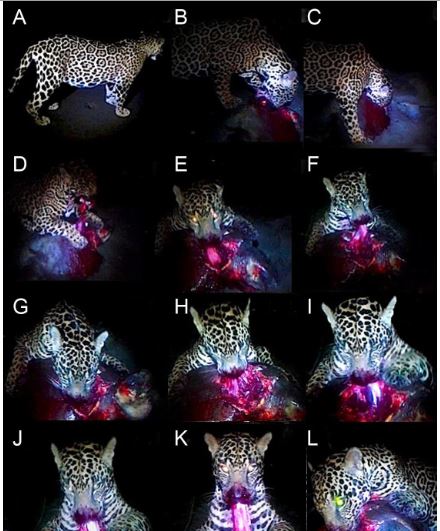
Jaguars have been recorded preying on adult female sea turtles on their nesting beaches in Costa Rica, Guyana, Mexico and Suriname (Fretey 1977, Autar 1994, Cuevas et al. 2014, Guildera et al. 2015). Jaguars prey on Green (Chelonia mydas), Olive Ridley (Lepidochelys olivacea), Hawksbill (Eretmochelys imbricata), and Leatherback (Dermochelys coriacea) sea turtles (see Fretey 1977, Autar 1994, Carrillo et al. 1994, Chinchilla 1997, Tröeng 2000, Heithaus et al. 2008, Veríssimo et al. 2012, Arroyo-Arce et al. 2014, Cuevas et al. 2014, Arroyo-Arce & Salom-Pérez 2015, Guildera et al. 2015). The capture effort and risk of injury associated with the predation of nesting sea turtles is expected to be lower relative to other prey species in the jaguar’s diet (Cavalcanti & Gese 2010). Additionally, they can be key resources when other pr ey availability is low (Veríssimo et al. 2012).
References
ARROYO-ARCE, S. & R. SALOM-PÉREZ. 2015. Impact of Jaguar Panthera onca (Carnivora: Felidae) predation on marine turtle populations in Tortuguero, Caribbean coast of Costa Rica. Biología Tropical 63: 815-825.
ARROYO-ARCE, S., et al. 2014. Habitat features influencing Jaguar Panthera onca (Carnivora: Felidae) occupancy in Tortuguero National Park, Costa Rica. Revista de Biología Tropical 62: 1449-1458.
AUTAR, L. 1994. Sea turtles attacked and killed by Jaguars in Suriname. Marine Turtle Newsletter 67: 11-12.
CAVALCANTI, S. & M. GESE. 2010. Kill rates and predation patterns of Jaguars (Panthera onca) in the southern Pantanal, Brazil. Journal of Mammalogy 91: 722-736.
CARRILLO, E., et al. 1994. Depredación de tortuga lora (Lepidochelys olivacea) y de tortuga verde (Chelonia mydas) por el Jaguar (Panthera onca). Vida Silvestre Neotropical 3: 48-49.
CHINCHILLA, F. A. 1997. La dieta del Jaguar (Panthera onca), el puma (Felis concolor) y el manigordo (Felis pardalis) en el Parque Nacional Corcovado, Costa Rica. Revista de Biologia Tropical 45: 1223-1229.
CUEVAS, E., et al. 2014. Marine turtles and Jaguars: two mystical species coexisting on the coast of Quintana Roo, México. Retrieved from http://casablancafishing.com/wpcontent/uploads/2013/07/Jaguars-and-Marine-Turtles.pdf
ELLIS, S. 2009. The Man Who Lives with Wolves. HarperCollins. 250 pp.
ESCOBAR-LASSO, S., et al. 2014. Los felinos silvestres del departamento de Caldas, en la región andina de Colombia: composición, distribución y conservación. Therya 5: 575588
FOSSEY, D. 1983. Gorillas in the Mist. Houghton Mifflin Company. 350 pp.
FRETEY, J. 1977. Cuases de motalite des tortues luth adults (Dermochelys coriacea) sur le littoral guayanais. Courrier de la Nature 52: 257-266
GOODALL, J. 1986 The Chimpanzees of Gombe: Patterns of Behavior. Harvard University Press, Boston. 400 pp
GUILDERA, J., et al. 2015. Jaguars (Panthera onca) increase kill utilization rates and share prey in response to seasonal fluctuations in nesting green turtle (Chelonia mydas mydas) abundance in Tortuguero National Park, Costa Rica. Mammalian Biology 80: 65-72.
HEITHAUS, M. R., et al. 2008. A review of lethal and non-lethal effects of predators on adult marine turtles. Journal of Experimental Marine Biology and Ecology 356: 43–51.
RICHARDSON, K. 2009. Part of the Pride: My Life Among the Big Cats of Africa. St Martins Pr Inc. 243 pp.
TROËNG, S. 2000. Predation of green (Chelonia mydas) and leatherback (Dermochelys coriacea) turtles by Jaguar (Panthera onca) at Tortuguero National Park, Costa Rica. Chelonian Conservation and Biology 3: 751-753.
VERÍSSIMO, D., et al. 2012. Jaguar Panthera onca predation of marine turtles: conflict between flagship species in Tortuguero, Costa Rica. Oryx 46: 340-347

This work is licensed under a Creative Commons Attribution-ShareAlike 4.0 International License.